


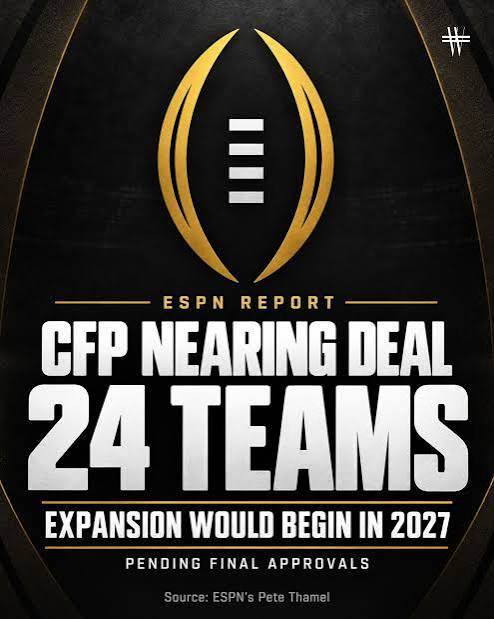

SEC commissioner Greg Sankey, Big Ten commissioner Tony Petitti and Notre Dame athletic director Pete Bevacqua held the most conversations with ESPN’s representatives. While there is still a lot more to be done about finalization. It seems that come next season, the College Football Playoff will be expanding to a 24-team structure. According to ESPN, “The College Football Playoff has reached a ‘handshake agreement’ with ESPN to broadcast a 24-team playoff beginning in the 2027 season, sources told ESPN on Friday.” What does this mean for the future of college football? Will this shake the foundation of a once-sturdy association?

Photo Cred: FOX
A 24-team playoff would mean more teams make the playoffs. There would be double the number of teams with a bye in the first round. The playoffs would start a week earlier. This would also eliminate the Power 4 conference championships, favoring the start of the playoffs. So the regular season winner of the Power 4 will get the top seeds.
According to ESPN, “Though final details have yet to be announced, discussions about the 24-team field have included 19 at-large bids, the Power 4 conference champions as determined by each league and the highest-ranked Group of 6 team.”
The greatest college football coach stated, “The bottom line is money. That’s the bottom line,” Saban said “You explained it. Universities need it because of the way we’re spending more now for players. There’s still a cost to having Olympic sports, which are important, I think to be able to keep and give people opportunities to compete. And how do we do that?”
Adding more teams to the playoff will equalize the opportunity for different schools to make the playoffs. This new playoff format will completely transform how future college football programs approach the postseason. Will a national championship have a higher value in a format where you have to play more games to win?
Photo Cred: FOX Sportss
Will we see more variation in postseason winners? How will fans and players alike adjust to the new schedule? All are valid questions for a format that has worked for years but is on its way out. While this is close to happening, it is not finalized. However, the next steps are not that far down the road. What’s the answer to all of these questions? Only time will tell.