

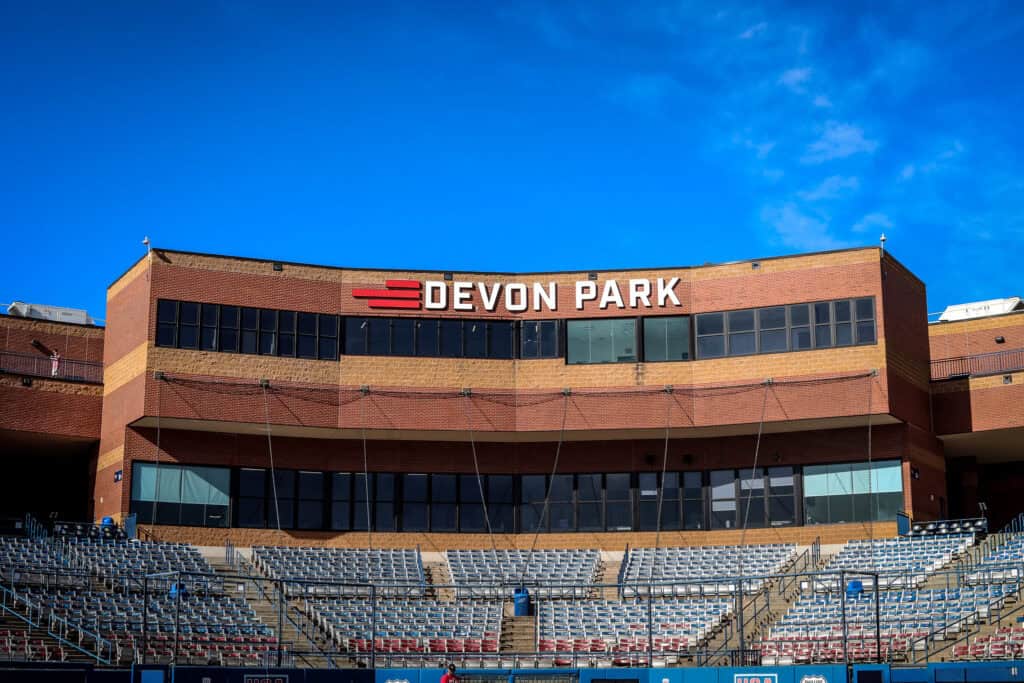

Mostly known as a football-huingry region, Okalhoma, due to their flagship university’s success on the diamond made the Sooner State a softball hotbed. As a result, when finding the ideal location as the 2028 Olympic softball venue, Oklahoma became the natural choice. I interviewed John Budd, CEO of the Oklahoma Department of Commerce.

Photo Cred: okcommerce
How will the Oklahoma Department of Commerce balance structural economic investments between the 2028 Olympic softball events at Devon Park and the canoe slalom events at Riversport Rapids to maximize the state’s total return on investment?
The state looks at return on investment a little bit differently from how private businesses or even cities do. These infrastructure improvements, supported by the Business Expansion Incentive Program (BEIP), will benefit the state long after the 2028 Olympics. Oklahoma is already the Softball Capital of the World, and our RIVERSPORT facility has long been a U.S. Olympic and Paralympic training site for rowing and kayaking, so we see the opportunity to showcase our upgraded facilities on the world’s largest sporting stage as a means to further cement Oklahoma’s reputation as a premier destination for elite athletics and international competition and attract additional events in the future.
Given that LA28’s agreement with the Greater Oklahoma City Chamber includes specific revenue and expense guarantees, what financial liabilities or backstops has the State of Oklahoma committed to protect taxpayers if local operational costs exceed projections?
Because we are helping build infrastructure, our safeguards are not tied to revenue or expense guarantees, and our financial contribution is capped. In the case for these BEIP awards made to USA Softball, RIVERSPORT and Oklahoma City University, the recipients must first demonstrate they have invested at least 10% of the project’s capital expenditures before any funds are awarded, plus remain in good standing with the Oklahoma Tax Commission. The payments come from payroll taxes in the form of quarterly rebates and will be distributed over a three-year period.
What specific strategies is your department deploying to leverage the global broadcast footprint of the 2028 Olympic softball tournament to attract foreign direct investment and international businesses to Oklahoma?
The fun thing about this opportunity is a lot of people don’t realize yet that Oklahoma is a co-host of the 2028 Olympics, and it’s the only location outside Southern California selected to host Olympic events. When we bring up that fact when meeting with other countries, they are eager to work together. For example, we recently met with a delegation from Australia to discuss their superannuation system and how they can invest in
Oklahoma. They hosted the ICF Canoe Slalom World Championships there in 2025 – a very popular spot there – and RIVERSPORT is hosting that same event this July. We’ve also given tours of Devon Park and RIVERSPORT to delegations from Thailand and other countries, so being a co-host of the 2028 Olympics is definitely opening doors for us when it comes to foreign direct investment (FDI). We plan to spend the next two years welcoming the world to Oklahoma for tourism and business. How do you plan to convert the short-term, 17-day economic surge of an estimated 200,000 Olympic visitors into long-term, sustainable tourism and commerce growth for the state, particularly for regions outside the immediate Oklahoma City metro area?
Oklahoma has ranked among the top 10 states for positive net migration for three consecutive years, and we are now seeing more people move from Texas to Oklahoma than the other way around. In recent years, Oklahoma has been on the global stage like never before, with the Oklahoma City Thunder’s postseason success, the centennial celebration of Route 66 and now the 2028 Olympic Games. When people from across the country and around the world visit our state for these events, they experience firsthand the Oklahoma way of life: a low cost of living, affordable energy and welcoming Main Street communities. We are confident that when people experience that firsthand, many of them will want to come back. Hospitality is just part of who we are. With hundreds of thousands of potential visitors and millions of eyes on Oklahoma during the Olympic Games, we will show the world that our state is not only a great place to visit, but the best place to live, raise a family and start a business.
With Devon Park already established as a premier global hub for softball, what additional infrastructure, transportation, or hospitality bottlenecks has the Department of Commerce identified that require immediate state-level funding or public-private partnerships before 2028?
Devon Park sits right next to the highway in the middle of the I-35 Corridor which is the fastest growing megalopolitan area in the country. That corridor connects San Antonio all the way north to Kansas City, but in Oklahoma our commute times still fall well below states like Texas and the national average. Oklahoma City specifically has low commute times, and our Department of Transportation has several projects on tap to allow traffic to continue to flow freely around and through our state.
How is the Department of Commerce collaborating with local business owners, especially minority- and women-owned small businesses, to ensure they are integrated into the Olympic supply chain and procurement processes for the softball events?
This past session, the Legislature allocated $15M for the Olympics preparation and we are working with the City of Oklahoma City to identify areas the need to be addressed ahead of 2028. This has language in the bill to ensure a portion of the money goes to Oklahoma-based businesses. This includes construction contractors, local event management firms, hospitality vendors and transportation and logistics companies. We want to make sure that everyone is prepared to meet the demand of this global moment.
From a workforce development perspective, how will your agency use the state’s role as an Olympic host city to bolster hospitality, event management, and sports tourism training programs to fill the surge in temporary and permanent jobs?
We are all hands-on deck for the event—the cities, the chambers of commerce, city and state tourism agencies, etc. Everyone knows this is a generational opportunity to welcome people to our state and make sure they have an exceptional time. We are also looking at long-term job implications. At the Department of Commerce, we are in the process of hiring a Director of Event-Driven Economic Development. Having hundreds of thousands of visitors is great, but our job is to capitalize on traffic and turn it into potential leads for business leaders looking to grow and expand their companies. This, in turn, will create new jobs and economic development opportunities for Oklahoma.
Given your extensive background in private sector corporate strategy and state agency operations, what specific performance metrics and key performance indicators (KPIs) is your office using to measure the economic success of the 2028 Games for Oklahoma?
While we are relying on our partners in RIVERSPORT and USA Softball for attendance numbers, we are also tracking which states attendees are visiting from, allowing us to better understand visitor impact and tax receipts after the events are over. The way Oklahoma is set up, the municipalities live and die on sales tax. Similar to when we had the 2025 NBA Finals, we are able to look at the data before and after the Olympics, in OKC and the surrounding communities, and look at how people are spending their dollars while they are here. We will also look at lead generation for potential business relocation to
Oklahoma, and ultimately business recruitment and expansion projects that result from visitation.
How does the Department of Commerce plan to mitigate potential economic displacement or logistical friction for regular, recurring events at Devon Park—such as the NCAA Women’s College World Series—during the lead-up and execution of the Olympic tournament?
The 2028 Women’s College World Series is scheduled to be completed in early June, and the Olympics start in until mid-July, so that won’t be an issue. Our venues have been cleared for the Olympics.
What long-term economic development initiatives or legacy projects is your department planning to launch post-2028 to ensure Oklahoma remains a competitive international destination for major sporting events well after the closing ceremonies?
Oklahoma is no stranger to hosting major national events. From the NBA Finals, to the Route 66 centennial, the Women’s College World Series every year, and even the Memorial Marathon, which is one of the premiere marathons in the country. Our state continues to rise to the occasion whenever we have the opportunity on the global stage. We always want to see more major events and conference being hosted here, that’s why we have programs like the Quality Events Act. We are looking forward to proving our ability to host this global event in our state, hopefully building commerce and tourism relationships with our visitors. Then we will work with our local cities to see what events and challenges we can take on next