Home Blog Page 82

UNLV NIL Scandal: Controversy Shaking Up College Athletics

0

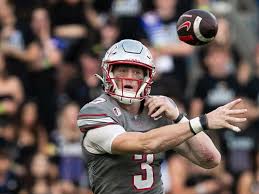
UNLV has been one of the surprise stories of this college football season. Their early success included a big road win over Kansas, which had fans excited and raised expectations for the season. However, the Rebels’ momentum hit an unexpected roadblock on September 24. Just days after their victory over Kansas, starting quarterback Matthew Sluka made a shocking announcement: he would be using his redshirt year and would not play another game for UNLV this season.
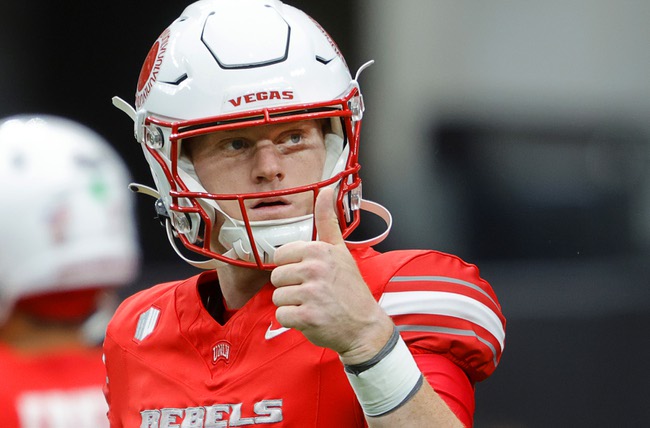
UNLV starting quarterback Matthew Sluka leaving team amid playoff push - Las  Vegas Sun News

Photo Cred: UNLV

Sluka took to X (formerly Twitter) to share his decision, stating, “I committed to UNLV based on certain representations that were made to me, which were not upheld after I enrolled. Despite discussions, it became clear that these commitments would not be fulfilled in the future.” This situation brings attention to the growing impact of Name, Image, and Likeness (NIL) deals in college sports and how they are affecting athletes and schools alike. While NIL rules allow athletes to profit from advertisements and endorsements, they have also introduced a new layer of complexity with the rise of “collectives.”

A collective is a fund that anyone can donate to, and the school can then distribute the money to athletes as they see fit. These collectives are often at the heart of disputes, such as the one involving Sluka. According to Sluka, an assistant coach had verbally offered him $100,000, which would have come from a collective. However, UNLV denies making any verbal financial offers. Instead, the school claims that Sluka’s representatives made financial demands for him to continue playing, a claim that has only deepened the conflict. For Sluka, what UNLV viewed as demands were simply his attempts to receive what he was promised.
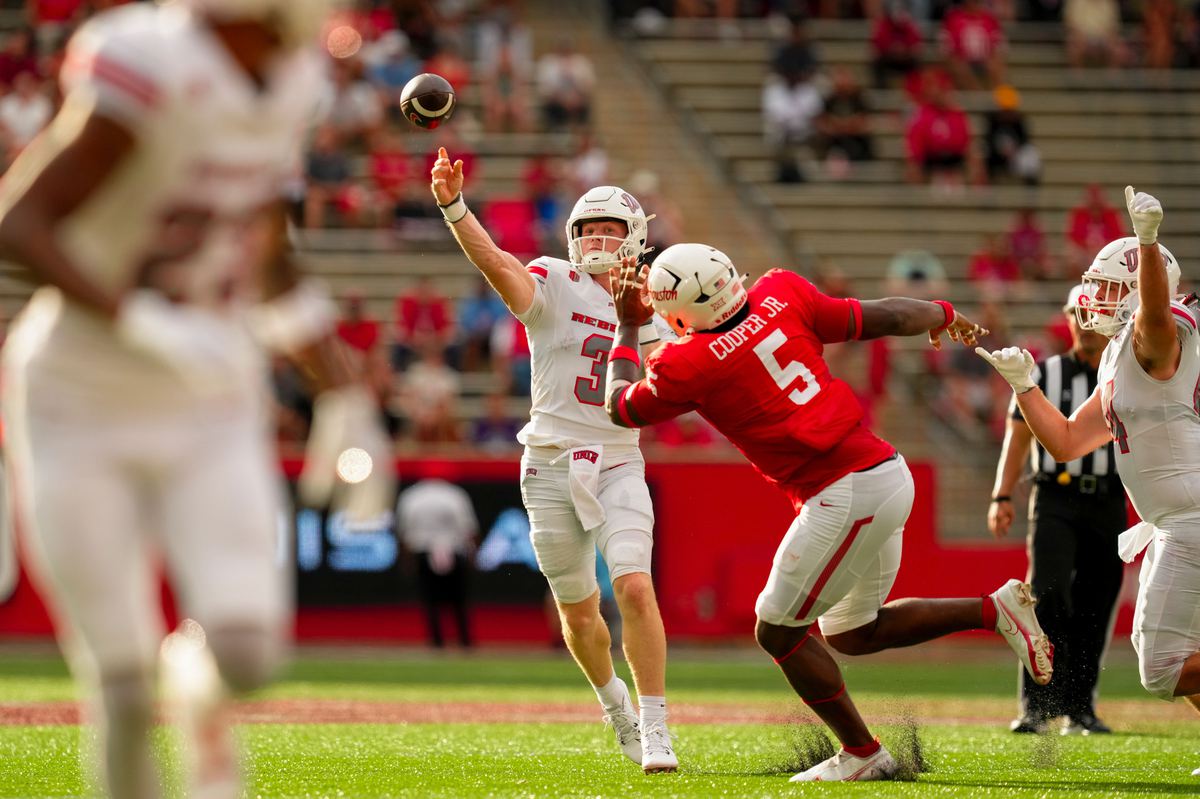
UNLV football has a playmaker in quarterback Matthew Sluka - Las Vegas Sun  News

Photo Cred: USA Today

With nothing in writing to substantiate either side’s claims, the dispute has devolved into a “he said, she said” situation that leaves fans and the NCAA in the dark. Whether or not UNLV made a verbal offer to Sluka, the situation underscores a larger flaw in the current NIL system. NIL began with the intention of allowing college athletes to profit from their marketability, such as being featured in advertisements. But in practice, it has evolved into what many see as a legal form of “pay-for-play,” especially with the introduction of collectives.

These funds can be used to entice athletes to attend certain schools or stay on their teams. And while powerhouse schools like Ohio State or Alabama may be able to offer their athletes lucrative deals, smaller schools often struggle to compete. Without formal contracts, verbal agreements or promises can be made without legal repercussions, leaving athletes and schools vulnerable to disputes like Sluka’s.

Since its approval in 2021, NIL has been a game-changer for college sports. Schools and athletes alike are still trying to adapt to this fast-moving landscape. While NIL has undoubtedly benefited many athletes by allowing them to capitalize on their fame, it has also opened up a Pandora’s box of problems for the NCAA to contend with.

The Matthew Sluka-UNLV situation is just one more example of how NIL can lead to confusion, broken promises, and tension between athletes and the schools they represent. While nothing will likely change overnight, this incident adds to the growing list of complications caused by NIL in college sports. With more cases like this likely to emerge, the NCAA will need to continue to refine its policies and address the ways NIL is changing the game—both on and off the field.
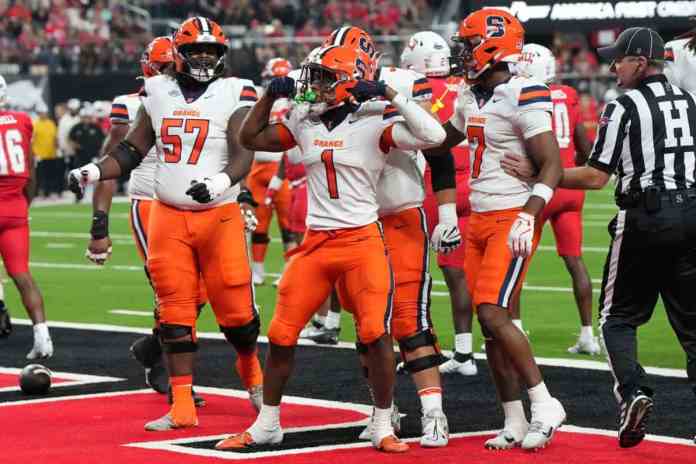
LeQuint Allen Leads Syracuse to Overtime Victory

0

Despite persistent issues on special teams, Syracuse managed to have the last laugh on Friday as LeQuint Allen powered into the endzone for the game-winning touchdown. In the first quarter, it looked like Syracuse was headed for a blowout. The Orange defense forced two early stops against UNLV, while long, sustained drives led by quarterback Kyle McCord quickly put Syracuse up 14-0. However, the #25-ranked Rebels didn’t back down. UNLV’s second-quarter comeback began with a 42-yard run by Jai’Den Thomas, setting up the Rebels in scoring position.

Syracuse Football PFF Grades: Oronde Gadsden II was great, but another TE  earned a better mark against UNLV - syracuse.com

Photo Cred: SU

Quarterback Hajj-Malik Williams soon threw a six-yard touchdown pass, and UNLV’s defense followed with its first stop of the game. The Rebels capitalized with a two-play drive featuring a 53-yard reception by Ricky White III and a three-yard touchdown scramble by Williams. It took UNLV less than half of the second quarter to erase the deficit, and they weren’t done yet.

Syracuse was forced to punt on their next possession, but disaster struck. UNLV’s punt block team pressured punter Jack Stonehouse so quickly that he couldn’t get the kick off, giving the Rebels the ball at Syracuse’s nine-yard line. Two plays later, Williams connected with Casey Cain for the go-ahead score, leaving Syracuse down 21-14 midway through the second quarter.

“We’re not going to flinch, and as long as he [Kyle McCord] and I don’t flinch, everyone else will stay on the same page,” said Fran Brown in a press conference.

When Syracuse desperately needed a long scoring drive, McCord and the offense delivered. A 16-play drive drained most of the remaining time in the half and resulted in a field goal. Though Syracuse regained some momentum, UNLV kept their lead, going into halftime ahead 21-17. Syracuse’s offense carried its momentum into the second half with another long drive, resulting in LeQuint Allen’s second touchdown reception, putting the Orange back in front. Williams then threw an interception two plays later, and Syracuse capitalized with a 21-yard rushing touchdown by Yasin Willis.

UNLV vs. Syracuse football: How to watch, TV channel, odds | UNLV Football  | Sports | UNLV

Photo Cred: SU

UNLV, now down and without momentum, responded with a long drive of their own, earning three points. At 31-24 near the end of the third quarter, UNLV forced Syracuse into another punting situation. This time, Stonehouse kicked the ball, but it was blocked by Ricky White III, and the ball bounced into the endzone, where it was recovered for the game-tying touchdown. With momentum slipping again, Syracuse mounted another long drive into the red zone.

But McCord threw an interception, preventing the Orange from regaining the lead with just eight minutes left in the fourth quarter. UNLV capitalized with a touchdown, leaving only three minutes on the clock. Down 38-31, Syracuse needed a touchdown to force overtime. Over the course of 11 plays, the Orange marched down the field and tied the game with a reception by Jackson Meeks. With time running out, Syracuse had a decision: go for two and the win or settle for overtime with the extra point.

“We train to go into overtime. We work for five quarters, so let’s play five quarters,” Fran Brown explained when asked why he didn’t go for the two-point conversion.

It proved to be the right decision. Syracuse’s defense held UNLV to a field goal in overtime. All Syracuse needed was a touchdown to win. After failing to convert on third-and-20, a critical UNLV penalty set the Orange up at the one-yard line. LeQuint Allen finished the job, powering through the defense to score the game-winning touchdown.

“As soon as we got the targeting penalty, I said, ‘We’re running the ball into the endzone,’” Fran Brown said.

Before Friday night, LeQuint Allen had scored just two touchdowns all season, one rushing and one receiving. But Coach Fran Brown knew Allen’s running would be key to victory.

“I looked over at [offensive coordinator Jeff] Nixon and said, ‘Feed LeQuint,’” Brown said.

Nixon took that to heart. Allen led the team in receptions and carries, rushing 19 times for 71 yards and two touchdowns while also catching nine passes for 58 yards and two more touchdowns. His performance was even more remarkable given that he played through an injury. Allen sustained a lower leg injury during the game. To keep his leg from tightening, Allen used a stationary bike and ran up and down the sideline. Despite the pain, he continued to perform at a high level.


UAB’s Season Takes All-time Low

0

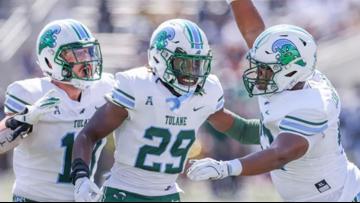
The UAB Blazers hit a new low this season, suffering the worst loss in franchise history with a 71-20 blowout against the Tulane Green Wave. The defeat is emblematic of what has been one of the most disappointing starts to a season in recent memory. Under the leadership of head coach Trent Dilfer, the Blazers have made headlines for all the wrong reasons, raising concerns about the direction of the program and what the future holds.

Football Runs Over UAB 71-20 - Tulane University Athletics

Photo Cred: UAB

Missing starting quarterback Jacob Zeno, UAB turned to junior Jalen Kitna to take the reins. Unfortunately, Kitna’s debut was a disaster. He threw three interceptions and completed just 21 of his passes, with four rushes resulting in -18 yards on the ground—a brutal average of -4.5 yards per carry. This is far from the promising start Kitna had hoped for, especially with a golden opportunity to impress under Dilfer’s guidance.

Despite the overwhelming disappointment, one bright spot for UAB has been the emergence of running back Lee Beebe Jr. The former walk-on continues to shine, rushing for 78 yards on just nine carries and adding 20 receiving yards in this game. His tenacity and resilience stand out even as the team struggles, and Beebe’s growing fanbase in Birmingham sees him as a future icon for the program.

Tulane Green Wave beats UAB Blazers 71-20 | wwltv.com

Photo Cred: Tulane

On the defensive side, the performance was nothing short of disastrous. While the players must take responsibility, much of the blame falls on the coaching staff and defensive coordinators. The play-calling was historically bad, with ineffective zone coverages and weak man-to-man schemes that left the Blazers vulnerable. Tulane capitalized by rushing for over 300 yards and scoring eight offensive touchdowns in front of 20,000 fans.

Looking ahead, UAB faces a crucial test next week as they travel to New York to take on the Army Black Knights. This game could be pivotal for the Blazers, not just in terms of their season but also for the future of the coaching staff. Extending their losing streak to five games would likely force the hands of the program’s executives, prompting significant changes in the offseason. For now, Dilfer and his team must find a way to rekindle hope and restore faith among their fans and supporters across the globe.

When Ducks Meet Spartans: Oregon vs. MSU Showdown

0

After a shaky start to the season, the No. 6 Oregon Ducks have found their rhythm and now seem poised to make a serious playoff push. Following a dominant 34-13 win over UCLA, Oregon sought to keep their momentum rolling against a struggling Michigan State squad on Friday. Despite a few miscues and missed opportunities, the Ducks managed to impose their will on the Spartans. They secured a 38-10 victory that was more one-sided than the score suggests.

MSU football vs. Oregon has been a meaningful and important series

Photo Cred: USA Today

The game began with sloppy play from both teams, particularly in the opening quarter. Michigan State’s quarterback, Aiden Chiles came into the game leading the FBS in turnovers. He added to his season’s woes with a costly fumble at the 1-yard line. That mistake set the tone for the rest of the night. While Chiles posted a somewhat respectable stat line of 10/17 passing for 154 yards, he struggled to handle the pressure from Oregon’s defense. He was never truly found his rhythm.

His inability to convert in key moments, along with Michigan State’s porous offensive line, kept the Spartans from finding the end zone. They were limited to a lone field goal until garbage-time touchdown. On the other side, Oregon’s typically sharp offense showed flashes of brilliance. But there were also concerning signs of inconsistency, particularly from quarterback Dillon Gabriel. Known as one of the most accurate passers in the nation, Gabriel had an uncharacteristically rough night, throwing two interceptions in the red zone during the first half.

Oregon-Michigan State final score: Ducks dominate Big Ten home opener

Photo Cred: USA Today

The first was an unfortunate misread, while the second was the result of a poorly timed pass under pressure. Despite those mistakes, Gabriel still put together an efficient performance. He finished with 257 yards on 20/32 passing with two touchdowns. Both coming in the second half as the Ducks pulled away. His overall completion percentage was lower than his usual standard, but his ability to bounce back after those turnovers helped stabilize the offense.

Without a doubt, the standout performer of the game was running back Jordan James. The junior from Nashville was a constant headache for Michigan State’s defense. He shredded them for a career-high 166 yards on 24 carries, with an impressive 6.9 yards per run. James showcased his explosiveness with a 40-yard run in the first half that set up a field goal. He found the end zone once on the night. His ability to break tackles and extend plays was key to Oregon’s clock control and offensive balance, allowing them to wear down the Spartans as the game progressed.

Defensively, Oregon’s senior edge rusher Jordan Burch made his presence felt from the first snap. Burch was a constant source of pressure on Aiden Chiles, registering 2.5 sacks, a fumble recovery, and numerous hurries that disrupted Michigan State’s offensive flow. Although his stat line of two total tackles doesn’t tell the whole story, Burch’s impact was undeniable. He was a thorn in the side of the Spartans’ offensive line all game long. He helped to keep Michigan State out of the end zone until the waning moments of the fourth quarter.

Takeaways, observations from Michigan State's lopsided loss to No. 6 Oregon - mlive.com

Photo Cred:

If it weren’t for James’ dominant performance, Burch likely would have been the clear MVP of the game. While Oregon’s performance was far from perfect, the game was never in doubt after halftime. Michigan State, meanwhile, looked overmatched and lacked the discipline needed to stay competitive. The loss only deepens their struggles, and they will need to reassess if they have any hope of making noise in the Big Ten this season.

For Oregon, though, the real test lies ahead. A game against Ohio State may  A win over Ohio State could catapult the Ducks into serious contention for a spot in the College Football Playoff, but another sloppy performance could spell trouble against a team of the Buckeyes’ caliber.


FWAA-NFF SUPER 16 POLL (Week 6 – Oct. 6)

Photo Cred: Super 16

FWAA-NFF SUPER 16 POLL (Week 6 – Oct. 6)
Ayokunle Spencer
WEEKLY SUPER 16
POLL
1 Texas
2 Ohio State
3 Georgia
4 Miami (FL)
5 Penn State
6 Oregon
7 BYU
8 Pittsburgh
9 LSU
1 0 Notre Dame
1 1 Texas A&M
1 2 Alabama
1 3 Indiana
1 4 Iowa State
1 5 Clemson
1 6 Tennessee

Ohio State Buckeyes Overcome Slow Start to Defeat Iowa 35-7

0
The Buckeyes delivered an impressive performance, defeating the Iowa Hawkeyes 35-7 in their first home Big Ten game of the season. The Hawkeyes, known for their formidable running attack and disciplined defense, presented a significant challenge for Ohio State, marking them as the toughest opponent the Buckeyes have faced thus far. In the first half, the Hawkeye defense showcased its strength, allowing only seven points and forcing two critical turnovers.
Ohio State football: How OSU grades after Big Ten win over Iowa
Photo Cred: Columbus Dispatch
Meanwhile, the Buckeyes’ defense was equally formidable, shutting out Iowa entirely and holding them to a mere 88 yards of total offense. As the second half unfolded, the momentum shifted dramatically in favor of the Buckeyes. Ohio State scored touchdowns on four consecutive possessions, effectively putting the game out of reach for the Hawkeyes.
The Buckeyes not only excelled offensively but also stepped up defensively, forcing turnovers on each of Iowa’s first three drives after halftime.
With a commanding 35-0 lead entering the fourth quarter, Ohio State substituted in some backup players, which allowed Iowa to finally get on the scoreboard and end the shutout.

Quarterback Will Howard was instrumental in the Buckeyes’ success. The QB completed an impressive 21 of 25 passes for 209 yards and four touchdowns. His versatility was on display as he also contributed 28 rushing yards and a touchdown.

USA TODAY Sports tabs Ohio State football as Week 6 winner

Photo Cred: USA Today

The receiving corps shone brightly, particularly Jerimiah Smith and Emeka Egbuka, who racked up all the passing touchdowns. Smith had a standout game with four catches for 89 yards and a touchdown. Including a highlight-reel one-handed catch during the third quarter that electrified teammates and fans alike. Egbuka was equally impressive, finishing with nine catches for 71 yards and three touchdowns. He reminded opponents that they can’t focus solely on Smith.

In the backfield, the dynamic duo maintained their productivity. They combined for 139 yards on 24 carries, even though they weren’t heavily relied upon this week. The Buckeyes may have started the game slowly. But their ability to overcome adversity and dominate the second half was a testament to their resilience and depth. Looking ahead, the Buckeyes face a significant test when they travel to Eugene to take on No. 3 Oregon.

After routing Iowa, Ohio State looks primed for Oregon football

Photo Cred: USA Today

This matchup has been highly anticipated. It marks the first time the Buckeyes and the Ducks will compete as Big Ten rivals, igniting a new chapter in college football history. Both teams enter the contest undefeated. It makes this showdown not only crucial for bragging rights but also pivotal in determining who will sit atop the Big Ten standings. With both teams eager to prove themselves, fans can expect an electric atmosphere and a fierce battle on the field.

Guardian Caps: A Review After Five Weeks of Use

0

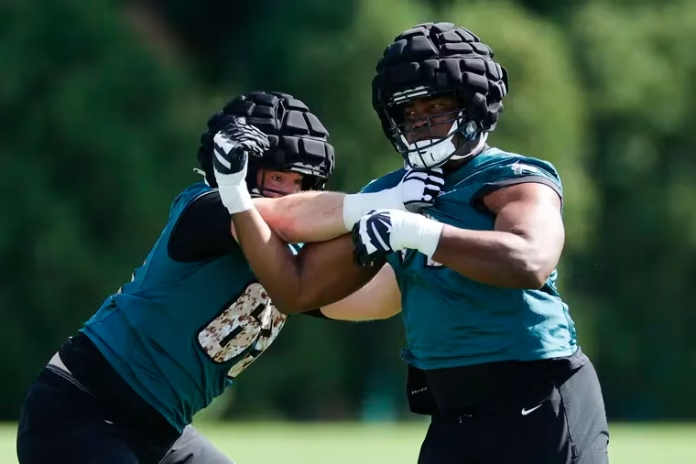
The NFL has made significant strides in recent years to enhance player safety. Particularly regarding head injuries, which have long been a concern in the sport. One of the most notable developments in this ongoing effort is the introduction of the Guardian Cap. It’s a padded protective shell designed to fit over standard football helmets. This innovative piece of equipment was initially introduced for use during practices in 2015. Its recent approval for use during games marks a critical advancement in player protection.

The N.F.L. Now Allows Helmet Caps - The New York Times

Photo Cred: Fox

By allowing players to wear the Guardian Cap on the field, the NFL aims to provide an additional layer of safety during gameplay, where the risks of head injuries are heightened. The Guardian Cap is engineered to absorb approximately 10% of the impact during hits in the NFL. A crucial statistic that highlights its potential effectiveness in reducing the severity of concussions. Interestingly, this percentage improves when the caps are used in lower levels of football, where the force of impacts tends to be less intense. This research underlines the cap’s versatility and its potential benefits for players across various age groups and skill levels.

As the understanding of head injuries continues to evolve, innovations like the Guardian Cap represent a proactive approach to minimizing concussion risks. It’s acknowledging that while they cannot be completely eliminated from the game, their occurrence can be significantly mitigated. Players have begun to recognize the importance of this protective gear. For instance, Matt Paradis, a center for the Carolina Panthers, has publicly expressed his support for the Guardian Cap. Emphasizing that “the science says it helps,” thereby removing any ambiguity about its effectiveness.

This sentiment resonates with many athletes who prioritize their health and longevity in the sport. Furthermore, to maintain team aesthetics and ensure that players feel confident in their gear, the Guardian Cap comes with a cover designed to mimic the look of the team’s standard helmet. This thoughtful design choice allows players to benefit from enhanced protection without compromising their team’s visual identity during games.

NFL's Medical Chief Says Guardian Caps Are An 'Unqualified Success'

Photo Cred: Forbes

As the NFL and other levels of football continue to prioritize player safety, the Guardian Cap represents a significant step forward in the fight against head injuries. Its growing acceptance among players suggests that it may soon become a standard part of game-day equipment. Ongoing research into the cap’s effectiveness and potential enhancements will be crucial as the sport evolves.

Additionally, the emphasis on safety is especially pertinent for younger athletes. They are particularly vulnerable to the long-term effects of head injuries. By integrating protective innovations like the Guardian Cap into the culture of football, the sport can better safeguard its players. They still preserve the competitive nature and excitement that fans cherish. This balance between safety and the essence of the game will be essential as the NFL navigates the future of player health and welfare.

Jayden Daniels & Jared Verse Named September Rookies of the Month

0
Photo Cred: USA Today
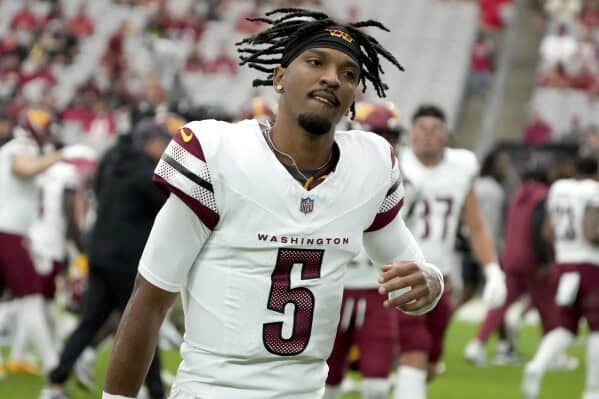
NEW YORK — Oct. 3, 2024 — Washington Commanders quarterback Jayden Daniels and Los Angeles Rams linebacker Jared Verse are the NFL Rookies of the Month for the month of September (Weeks 1-4).

OFFENSE: QB JAYDEN DANIELS, WASHINGTON COMMANDERS

  • Daniels led the league in completion percentage (82.1 percent), led quarterbacks in rushing touchdowns (four), ranked second among quarterbacks in rushing yards (218), ranked third in passer rating (107.4, minimum 75 attempts) and had 897 passing yards and three touchdown passes in the month of September. His 82.1 completion percentage (87 of 106) surpassed Tom Brady (79.2 percent, 95 of 120, in 2007) for the highest completion percentage (minimum 75 attempts) by a player in his team’s first four games of a season in NFL history.
  • Daniels becomes the third Washington player to win Offensive Rookie of the Month and the first since 2012, joining Robert Griffin III (September and November, 2012) and Chris Samuels (October, 2000).
  • Daniels is the first former Louisiana State quarterback to win Rookie of the Month and 11th Tiger overall to earn the honor.

DEFENSE: LB JARED VERSE, LOS ANGELES RAMS

  • Verse led all rookies with five tackles for loss and had 19 tackles, one sack and one forced fumble in the month of September. He was the only rookie to record four-or-more tackles in each game this month. 
  • Verse becomes the sixth Ram to win Rookie of the Month and the second defensive player to earn the honor, joining Kobie Turner (December, 2023).
  • Verse joins Brian Burns (September, 2019), Sam Cowart (October, 1998) and Peter Boulware (September, 1997) as the only former Florida State linebackers to win Defensive Rookie of the Month.
For more from NFL Communications, visit media.nfl.com

Sam Darnold, Aidan Hutchinson & Brandon Aubrey Named September NFC Players of the Month

0

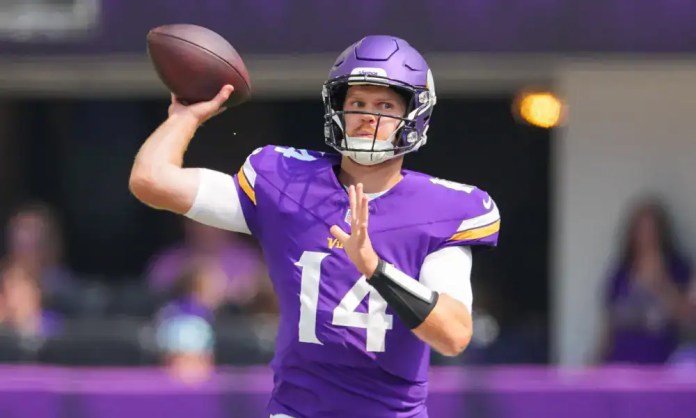
NEW YORK — Oct. 3, 2024 — Minnesota Vikings quarterback Sam Darnold, Detroit Lions defensive lineman Aidan Hutchinson and Dallas Cowboys kicker Brandon Aubrey are the NFC Players of the Month for the month of September (Weeks 1-4).

OFFENSE: QB SAM DARNOLD, MINNESOTA VIKINGS

  • Darnold led the NFL in touchdown passes (11) and passer rating (118.9) in September, becoming the sixth different quarterback to record at least two touchdown passes and a passer rating of 105-or-higher in each of his team’s first four games of a season, joining Tom Brady (2007 and 2015), Pro Football Hall of Famer Peyton Manning (2013), Aaron Rodgers (2011 and 2020), Matt Ryan (2016) and Russell Wilson (2020).
  • This is Darnold’s first-career Player of the Month honor. He is the third Vikings quarterback to earn Offensive Player of the Month in the past 15 seasons, joining Kirk Cousins (October, 2019) and Case Keenum (November, 2017).
  • Darnold is the third former University of Southern California player to earn Offensive Player of the Month, joining Matt Cassel (November, 2010) and Carson Palmer (September, 2005).

DEFENSE: DL AIDAN HUTCHINSON, DETROIT LIONS

  • Hutchinson led the league with 6.5 sacks in September and according to Next Gen Stats, led all players with 25 quarterback pressures during the  month. He recorded a career-high 4.5 sacks in Week 2, becoming the fourth player since 1982, when the individual sack became an official statistic, to record a game with three-or-more sacks in each of his first three career seasons, joining Justin Houston, Jevon Kearse and Pro Football Hall of Famer Reggie White.
  • This is Hutchinson’s first-career NFC Player of the Month honor. He is the fourth Lions player to earn Defensive Player of the Month, joining Stephen Boyd (November, 1998), Ray Crockett (November, 1991) and DeAndre Levy (September, 2014).
  • Hutchinson is the ninth former University of Michigan player to earn Player of the Month honors and the third to win Defensive Player of the Month, joining Pro Football Hall of Famer Charles Woodson (five times) and LaMarr Woodley.

SPECIAL TEAMS: K BRANDON AUBREY, DALLAS COWBOYS

  • Aubrey led all players with 12 made field goals in September, including a league-high six made field goals from 50-or-more yards. In Week 3, he made a 65-yard field goal, the second-longest field goal in NFL history and along with a 60-yard field goal in Week 4, became the fourth kicker in NFL history with at least three made field goals of 60-or-more yards, joining Brett Maher (four), Matt Prater (three) and Greg Zuerlein (three).
  • This marks the third-career Player of the Month honor for Aubrey, who won the Award in October and December last season.
  • Aubrey becomes the third former Notre Dame player to earn at least three Player of the Month honors, joining John Carney (five) and Jerome Bettis (three).

Innovations in Player Safety Help Drive NFL Preseason Concussions to Record Low

0
Photo Cred: NFL


2024 sees fewest number of concussions for a full preseason since 2015, along with other positive injury reduction trends

NEW YORK – Oct. 4, 2024 – The National Football League announced today injury data for the 2024 preseason, which includes the fewest number of concussions in a full preseason. Key results include:

  • The fewest number of concussions in practices and games (44) since tracking began in 2015
  • A nearly 50% reduction in concussions among players wearing the Guardian Cap in mandated sessions vs. the pre-mandate average
  • Lower-extremity strains remain down by roughly 25%
  • 70% of kickoffs were returned in the preseason, with the injury rate on returns decreasing by 32% to more closely align with the injury rate on run and pass plays
  • Nearly 99% of players in top-performing helmets

Concussions reach an all-time low

The decrease in preseason concussions to an historic low resulted from the long-term, holistic approach to concussion reduction efforts. The strategy includes rule changes, research into better understanding of concussion causing events, education related to proper technique, improved helmet safety and the expansion of the Guardian Cap mandate. The 44 concussions represent a decrease of 24% from 2023 and fewer than half the number of 91 in 2017.

“Concussions continue to decrease in the preseason as a result of changes to practices, technique, rules and substantial investments in research that have led to the best performing helmets we have ever seen,” said Jeff Miller, NFL Executive Vice President overseeing Player Health and Safety. “There is more work to do, but player safety is advancing, and we hope to see this trend continue this season.”

“While there is no finish line in our efforts to make the game safer, the injury data from this preseason is an example of how the league’s deliberate approach to player safety continues to deliver results,” said Dr. Allen Sills, NFL Chief Medical Officer. “We’re committed to building a culture of safety around the game, and this preseason was another positive step in that direction.”

Continued progress on lower-extremity injuries

Multi-year strategies to reduce lower-extremity injuries in the preseason continued in 2024, following a sustained decreased during the 2023 preseason. The league continues to track the progress and success of the mandated preseason acclimation strategy, where players gradually reintegrate into football activities at the start of training camp to decrease the risk of injury as they ramp up to in-season performance levels.

The injury data this preseason supports that the mandated ramp-up period – paired with targeted, club-by-club discussions about injury reduction strategies – continues to have a significant impact. Since the acclimation period was introduced in 2022, lower-extremity strains remain down by 27% in 2024 compared to the 2021 preseason. ACL tear injuries this preseason remained lower than the nine-season average, while Achilles rupture injuries were lower than 2023 and comparable to the nine-season average.

Kickoff rule change shows promising early returns

This year’s preseason injury data is also the first to reflect the new Dynamic Kickoff rule. With the new rule in place, 70% of kickoffs were returned in the preseason while player speeds on the play decreased approximately 20%. The injury rate on returns decreased by 32%, more closely aligning with the rate of injuries on run and pass plays.

Helmet adoption rate points to further progress

This season, five of the helmet models available for players tested better than any helmet ever worn in the league. The record 12 new helmets available for this season also include eight new position-specific helmet models.

Nearly 99% of players are wearing top-performing models, including more than 250 players wearing helmets that provide as much – and in some case more – protection than a helmet paired with a Guardian Cap; players wearing these helmets are not required to wear the Guardian Cap in practices.

Media Contact: Stef Goodsell, Stef.Goodsell@nfl.com

For more from NFL Communications, visitmedia.nfl.com