Home Blog Page 54

The Best NBA Playoff Performances of All Time: Part One

The NBA playoffs are the true proving ground for greatness. While regular season success builds stars, it’s in the postseason that legends are made and legacies are solidified. In this multi-part series, we break down some of the most impactful and iconic playoff performers in NBA history. Here’s Part One, counting down from 10 to 6.


10. Kobe Bryant – Five-Time NBA Champion, Two-Time Finals MVP

Kobe Bryant began his postseason legacy as the explosive sidekick to Shaquille O’Neal, forming one of the most dominant duos the league has ever seen. During the Lakers’ three-peat from 2000 to 2002, Bryant posted impressive playoff averages of 25.3 points, 5.7 rebounds, 4.9 assists, 1.5 steals, and 1.1 blocks per game — production that far exceeded the typical “Robin” role.
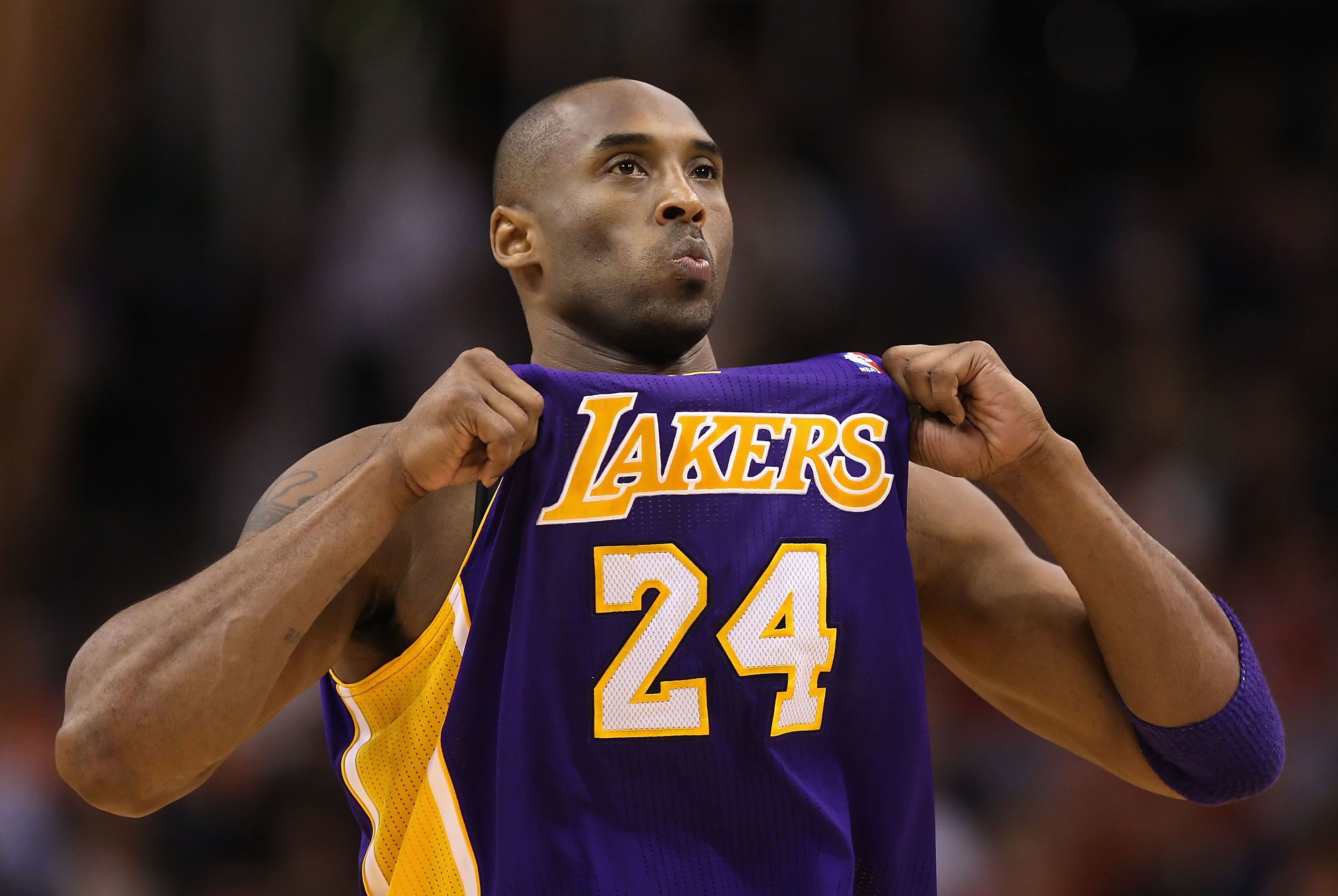
Being a great basketball player wasn't enough for Kobe Bryant | CNN

Photo Cred: CNN

After O’Neal’s departure, Kobe emerged as the undisputed leader of the Lakers. In nine playoff campaigns from 2003 onward, he raised his game even further, averaging 28.7 points, 5.2 rebounds, and 5.1 assists per contest. He led Los Angeles to two more championships in 2009 and 2010, earning Finals MVP honors each time. With five rings and countless clutch moments, Bryant’s legacy is etched in postseason excellence.


9. Stephen Curry – Four-Time NBA Champion, 2022 Finals MVP

Stephen Curry changed the way basketball is played. His unmatched shooting range and off-ball movement stretched defenses to their limits and created an entirely new offensive ecosystem. Though stats only tell part of the story, they still underscore his brilliance.

Through nine playoff appearances, Curry has averaged 27.0 points, 6.2 assists, 5.3 rebounds, 4.2 made threes, and 1.5 steals per game, while maintaining a near-40% mark from deep. No other player with at least 1,000 playoff minutes matches that statistical combination. Curry’s presence alone disrupted opposing game plans, and his ability to shine on the biggest stage — culminating in a Finals MVP in 2022 — secures his place among the all-time great postseason performers.


8. Bill Russell – 11-Time NBA Champion

Bill Russell’s playoff résumé is unmatched in one category: winning. With 11 titles in 13 seasons, Russell set a standard for dominance that has yet to be approached. As the foundation of the Celtics’ dynasty, he brought leadership, tenacity, and elite defense to every postseason battle.

Bill Russell | Center | Boston Celtics | NBA.com

Photo Cred: NBA

Between 1957 and 1969, Russell averaged 24.9 rebounds, 16.2 points, and 4.7 assists per game in the playoffs. Though blocks weren’t officially recorded during his era, contemporaries and historians agree he was the premier rim protector of his time. Russell wasn’t just a statistical force — he was a culture-setter, the heartbeat of a team that defined a generation of winning.


7. Tim Duncan – Five-Time NBA Champion, Three-Time Finals MVP

Nicknamed “The Big Fundamental,” Tim Duncan’s playoff success was built on consistency and versatility. For two decades, he was the San Antonio Spurs’ anchor, delivering elite two-way production in nearly every postseason run.

Duncan appeared in 72 playoff games with at least 20 points, 10 rebounds, and two blocks — second only to Shaquille O’Neal in that category. He averaged 20.6 points, 11.4 rebounds, 3.0 assists, and 2.3 blocks across his playoff career, with 15 postseason runs of at least 100 points, 50 rebounds, and 10 blocks — more than any player in history. Year after year, Duncan was the model of playoff dependability, guiding the Spurs to five championships with quiet dominance.


6. Kareem Abdul-Jabbar – Six-Time NBA Champion, Two-Time Finals MVP

Kareem Abdul-Jabbar’s playoff career spanned two decades and two franchises — and in both stops, he was a force to be reckoned with. His signature sky hook was virtually unguardable, and his impact on both ends of the floor made him one of the most complete big men in postseason history. With the Lakers, Kareem averaged 22.6 points, 8.5 rebounds, 3.0 assists, and 2.4 blocks in the playoffs.

Legends profile: Kareem Abdul-Jabbar | NBA.com

Photo Cred: NBA

His numbers with the Milwaukee Bucks were even more dominant. He put up 29.7 points, 16.8 rebounds, 4.0 assists, and 2.4 blocks per game (with blocks recorded in only his final season there). From scoring efficiency to shot-blocking to veteran leadership, Kareem was an all-time playoff performer who delivered when it mattered most.
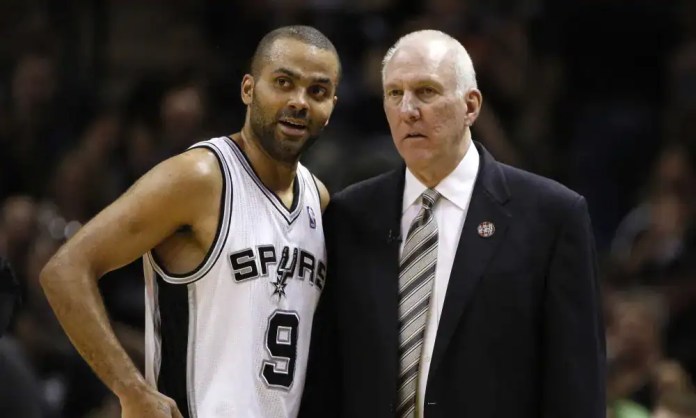
The Spurs Standard: A Legacy That Transcends Championships

Photo Cred: Spurs Wire

Gregg Popovich is more than a coach — he is an institution. Widely regarded as one of the most accomplished and influential figures in NBA history, Popovich’s name has become synonymous with sustained excellence, disciplined basketball, and a culture that prioritized integrity as much as victory. Over nearly three decades with the San Antonio Spurs, he built not just a dynasty, but a blueprint for how a franchise can succeed with consistency, humility, and purpose. Popovich’s résumé is staggering.

Gregg Popovich introduces himself as 'El Jefe' of Spurs

Photo Cred: USA Today

He holds the NBA records for both most regular season wins and most playoff victories, milestones that speak to his long-term mastery of the game. Under his guidance, the Spurs captured five NBA championships (1999, 2003, 2005, 2007, and 2014), each representing a different phase of the team’s evolution but always unified by the same core principles: teamwork, preparation, and unselfish play. What makes his record even more impressive is the era-spanning nature of his success. From the grind-it-out games of the late ’90s to the pace-and-space era of the 2010s, Popovich adapted his strategies without ever compromising the identity of the team.

During his tenure, the Spurs achieved winning records against every other NBA franchise — a testament to his consistency and competitive edge. Perhaps the most telling measure of Popovich’s greatness is his consistency in a league known for its volatility. Across 29 seasons, he led the Spurs to 22 winning campaigns and nearly annual playoff appearances. While rosters changed, stars aged, and the league evolved around him, Popovich remained the steady force behind one of the most stable and respected organizations in professional sports.

His success wasn’t built on star power alone—it was grounded in culture. Popovich cultivated a selfless, team-first environment where discipline was expected and egos were checked at the door. That culture turned San Antonio into a destination for players who valued winning the right way. Popovich’s legacy reaches well beyond Xs and Os. He was instrumental in the development of future Hall of Famers like Tim Duncan, Manu Ginobili, and Tony Parker—players who defined the Spurs’ golden era and whose games blossomed under his mentorship.

Gregg Popovich, the NBA's all-time wins leader, retires after 29 seasons as  coach in San A

Photo Cred: WJLA

But his influence extended even further: role players thrived in San Antonio’s system, often playing the best basketball of their careers. Moreover, his coaching tree is among the most influential in the league today. Former assistants and players have gone on to lead teams across the NBA, many citing Popovich’s leadership, values, and basketball philosophy as cornerstones of their own approach. Still, the debate over whether Popovich is the greatest coach of all time is not without its complexities.

Some critics point out that much of his success came in a pre-analytics, pre-three-point-revolution NBA. Today’s game is faster, more perimeter-oriented, and positionless—factors that some argue would challenge the systems he once mastered. Additionally, Popovich benefited from something increasingly rare in modern pro sports: organizational stability. With a unified front office, consistent ownership, and long-tenured stars, the Spurs were uniquely equipped for long-term success.

Critics suggest this environment, while not taking away from his brilliance, may have given him an advantage over peers coaching in more turbulent settings. Popovich’s accomplishments extend beyond the NBA. As head coach of the U.S. men’s national basketball team, he led the squad to a gold medal at the 2020 Tokyo Olympics, reaffirming his ability to command the respect and performance of the game’s best players on the international stage.

Gregg Popovich, the NBA's all-time wins leader, retires after 29 seasons as  coach in San Antonio - WDIO.com

Photo Cred: WDIO

In 2023, his contributions to the sport were immortalized with his induction into the Naismith Memorial Basketball Hall of Fame — an honor that not only recognized his on-court achievements but also his impact on the broader basketball community. In 2025, after 29 seasons on the sidelines, Popovich stepped down as head coach of the Spurs, closing a monumental chapter in NBA history. He transitioned into a new role as president of basketball operations for the franchise he helped define.

Even off the court, his influence on the game and the organization he shaped will continue. Whether Gregg Popovich is the greatest NBA coach of all time may forever be up for debate. But what cannot be disputed is that he redefined what greatness looks like in professional basketball. With unmatched longevity, unmatched humility, and a legacy that has changed the sport both on and off the court, Popovich stands not just among the greatest — he stands apart.

A Record Breaking Derby in Louisville, Ky

Photo Cred: BR

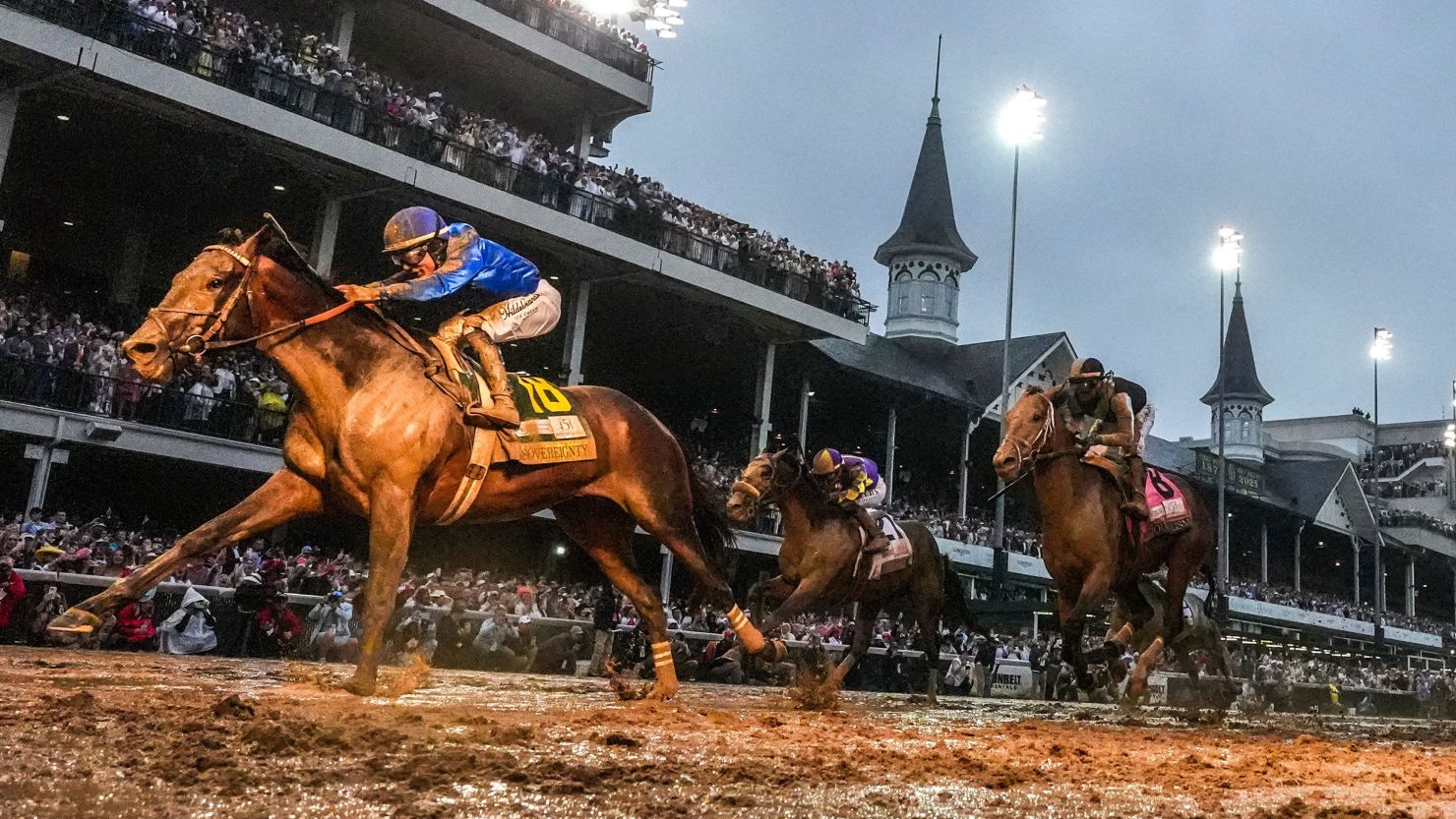
The 151st running of the Kentucky Derby proved to be a historic one—not just on the racetrack, but in living rooms across the country. Held at the iconic Churchill Downs in Louisville, Kentucky, the Derby captivated the nation with dramatic conditions, a surprise winner, and record-breaking broadcast numbers. The race portion of the day averaged an impressive 17.7 million viewers, making it the most-watched Derby broadcast since 1989, when 18.5 million tuned in.

Sovereignty wins the 151st Kentucky Derby | CNN

Photo Cred: CNN

The number marks a substantial increase from last year’s total of 16.7 million, signaling a renewed surge of interest in one of America’s oldest and most celebrated sporting traditions. NBC’s coverage benefited not only from the excitement on the track but also from the growth of digital platforms. Streaming viewership jumped 34% compared to 2024, with 959,000 people watching online—up from 714,000 the previous year. This suggests a growing audience among younger, tech-savvy fans who prefer to watch live events on mobile and connected devices.

Perhaps most notably, the quarter-hour encompassing the race itself and the immediate aftermath drew a peak of 21.8 million viewers. That segment marks the highest-rated moment of NBC’s coverage since it acquired broadcast rights to the event in 2021. This spike reflects the immense anticipation surrounding the “Run for the Roses” and the national draw of live sporting drama.

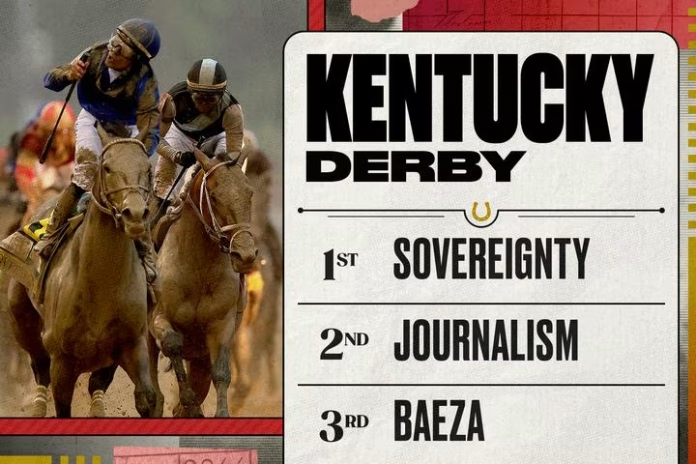
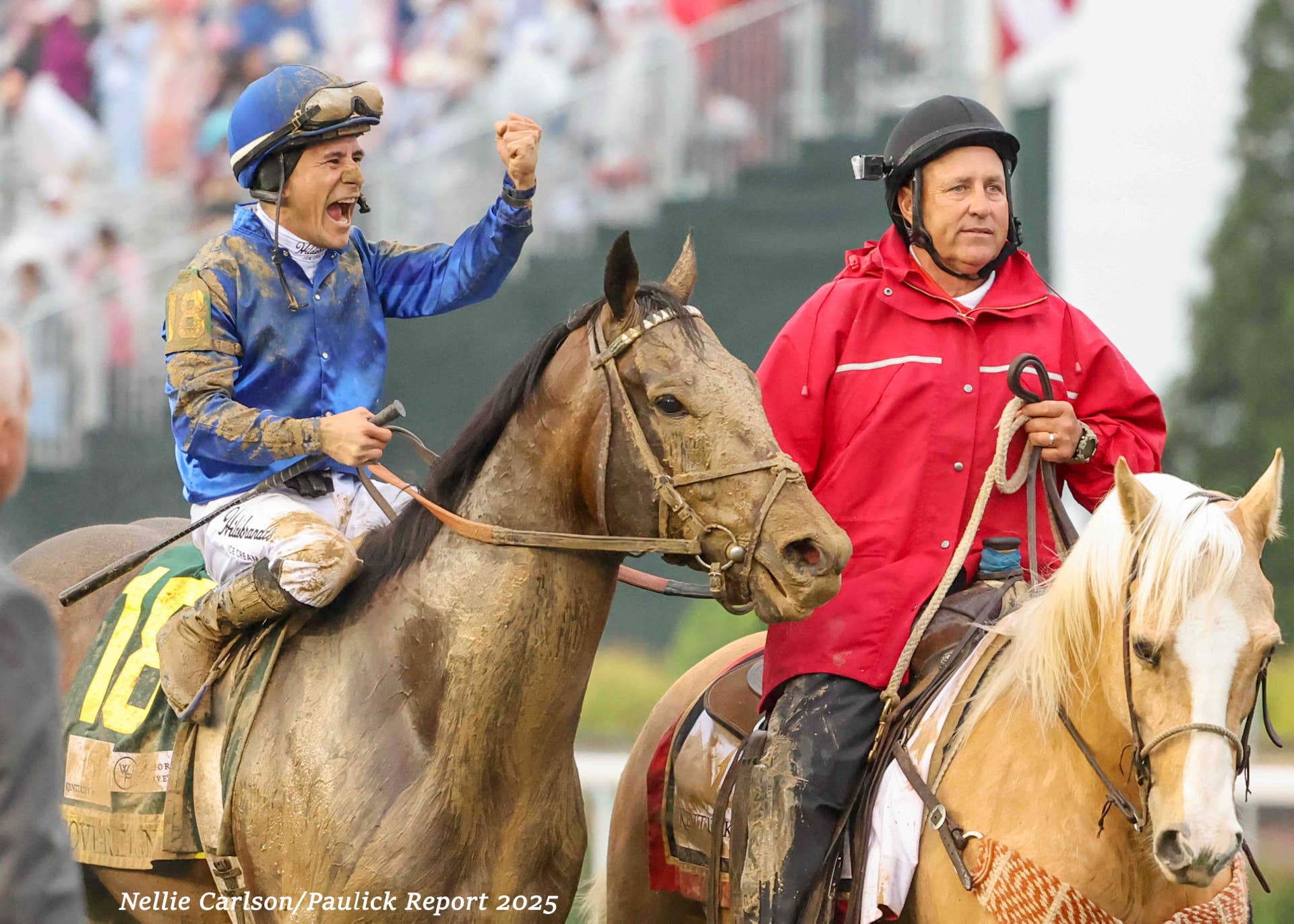
On the track, Sovereignty delivered that drama in full. Entering the race with 9-1 odds, the colt surged to victory under muddy and treacherous conditions, taking the win in front of a packed crowd and millions watching at home. Sovereignty’s triumph was seen as an upset, as he outpaced a field of top contenders. Journalism and Baeza finished second and third, respectively, rounding out a thrilling top-three in a race that remained competitive from start to finish.

Hall of Fame trainer Bill Mott noted that his horse suffered “a small scrape – about four inches” on his right front pastern during the running, likely when he clipped heels with a rival right out of the gate. He said it was nothing serious, but that anything to do with a horse’s legs are always a concern.

“When I got back to the barn last night after the race,” he noted further, “he’d already eaten up, his tub was empty. Probably did it in 20 minutes. That’s unusual for a horse that had to run a race as hard as he did.”

It's More Than Even A Dream': Sovereignty Reigns In Kentucky Derby - Paulick Report | Latest news and commentary from the horse racing and equine world

Photo Cred: paulickreport

The conditions themselves added an additional layer of challenge and spectacle. Torrential rain fell throughout the day, turning the legendary Churchill Downs track into a quagmire. Still, the poor weather didn’t deter fans. A crowd of 147,406 spectators braved the elements to witness the historic race in person—demonstrating the enduring passion for the Derby, rain or shine.

This year’s success is not just a win for the sport of horse racing, but also for NBC and event organizers who have worked in recent years to expand the Derby’s appeal across platforms and demographics. From traditional broadcast audiences to digital streaming, the Kentucky Derby continues to evolve while maintaining its place as a cornerstone of American sports culture.

As the Triple Crown season continues with the Preakness Stakes and Belmont Stakes on the horizon, all eyes will now be on Sovereignty to see if he can continue his remarkable run. For one afternoon, however, the combination of tradition, surprise, and spectacle made the 2025 Kentucky Derby an unforgettable event—both on the muddy track and across millions of screens nationwide.

Washington, D.C. to Host 2027 NFL Draft

Photo Cred: DC Events

NEW YORK — May 5, 2025 — The NFL today announced that the 2027 NFL Draft presented by Bud Light will take place in Washington, D.C, uniting fans from around the world to celebrate one of the most- anticipated events in sports.

Hosted in partnership with Washington Commanders and the local organizing committee, Events DC, the 2027 NFL Draft will take place across the District’s most iconic landmarks, including the National Mall and Pennsylvania Avenue, placing the capital at the center of America’s most celebrated sport.

The announcement was made today in the Oval Office with President Donald J. Trump.

“The NFL Draft has become a marquee event, uniting fans across the country and around the world,” said NFL Commissioner Roger Goodell. “We are excited to bring the 2027 Draft to Washington, D.C., a city rich in history and national pride. With the support of President Trump, the Commanders, Events DC, and Mayor Bowser we’re looking forward to delivering an unforgettable experience as we celebrate the next generation of NFL stars.”

Over the course of the three-day event, D.C. will host a slate of Draft activities, including a variety of community events, the Draft Concert Series and the NFL Draft Experience – the ultimate free fan festival. that invites fans to participate in immersive exhibits, challenge their skills in interactive games, take photos with the Vince Lombardi Trophy; enjoy the youth-focused Play 60 Zone; shop exclusive NFL merchandise; and score autographs from current players and Legends.

“The NFL Draft is one of the biggest moments in sports—and we’re incredibly proud to help bring it to Washington, D.C.,” said Josh Harris, Commanders Managing Partner. “It will bring hundreds of thousands of visitors, millions of viewers around the world, and generate jobs, tax revenue, and meaningful economic impact across the city. The Draft is a powerful reminder of how sports bring people together – and we’re honored to play a role in that. Since we started this journey less than two years ago, we’ve seen an NFC Championship Game, an agreement to return to RFK, and now the NFL draft in Washington. Thank you to President Trump for your leadership, to Mayor Bowser for your partnership, and to Commissioner Roger Goodell for your support in bringing the Draft back to the nation’s capital. We look forward to welcoming the football world to Washington in 2027. Today is a great day for the DMV, and I can’t wait to see what the future brings.”

“This is a historic occasion for Washington, DC, and we are absolutely honored to host the 2027 NFL Draft,” said Events DC President and CEO Angie M. Gates. “The NFL Draft will provide football fans with an unforgettable experience, while showcasing all that makes Washington, DC a world-class destination and the Sports Capital. We look forward to working with our partners and community to deliver a world-class event that reflects the dynamic spirit of our city.”

Since 2015, the NFL Draft has continued to grow as one of the most-watched events in sports, with over 3.5 million fans attending festivities in person. The 2024 NFL Draft in Detroit attracted a record-breaking 775,000 fans. Most recently, more than 600,000 fans attended the 2025 NFL Draft in Green Bay, matching Nashville’s record in 2019 for the second-highest attendance in Draft history.

Assets Available Here

Media Contact: 

Sam Roth, samantha.roth@nfl.com

Paula Ngon, paula.ngon@nfl.com

2025 NFL Draft is Second Most-Watched Draft Ever

Photo Cred: USA Today
NEW YORK — April 29, 2025 — The 2025 NFL Draft in Green Bay was seen by an average audience of 7.5 million viewers across ESPN, ABC, NFL Network, ESPN2, ESPN Deportes and digital channels for the three-day event, making it the second most-watched Draft on record behind only 2020 and up +27% versus last year.

All seven rounds of the 2025 NFL Draft were presented across ESPN, ABC and NFL Network – the seventh straight year that The Walt Disney Company worked with the National Football League to offer a multi-network presentation of the Draft.

Round 1 coverage on Thursday averaged 13.6 million viewers across ESPN, ABC, NFL Network, ESPN Deportes and digital channels – up +11% versus 2024 and the second most-watched Day 1 on record.

Coverage of Rounds 2 and 3 on Friday averaged 7.5 million viewers across ESPN2, ABC, NFL Network, ESPN Deportes and digital channels – the second most-watched Day 2 on record and up +48% versus 2024.

Saturday’s coverage of Rounds 4-7 averaged 4.3 million viewers across ESPN, ABC, NFL Network, ESPN Deportes and digital channels, making it the most-watched Day 3 on record and up +43% versus 2024.

Over the three days, more than 600,000 fans attended the 2025 NFL Draft in Green Bay, matching Nashville’s record in 2019 for the second-highest attendance in Draft history.

NFL programming is the most valuable content in all of sports and entertainment. NFL games ranked as 90 of the top 100 telecasts during the 2024 season.

For the latest news on NFL Media – comprising of NFL Network, NFL Films, NFL.com, NFL+, the NFL app, NFL RedZone and free ad-supported television streaming service NFL Channel – please follow @NFLMedia on X and Instagram. Additionally, for general league news visit media.nfl.com.

Source: Nielsen panel viewership + first-party streaming

Media Contact: Andrew Howard, Andrew.Howard@nfl.com

For more from NFL Communications, visit  media.nfl.com

246 High Schools Have Players Selected in 2025 NFL Draft

Photo Cred: X
NEW YORK — May 1, 2025 — With the conclusion of the 2025 NFL Draft, this year’s class of drafted rookies will soon begin life in the NFL.

While each drafted rookie enters the NFL from a different background, the one thing they all have in common is an outstanding experience playing high school football. A total of 246 high schools contributed to the 257 players selected in the seven rounds of the April 24-26 Draft.

“The NFL Draft is a powerful bridge between college football and the National Football League,” said Roman Oben, NFL Vice President of Football Development. “Each year, lifelong dreams come true the moment a player’s name is called. Those emotional moments – shared with family and friends on national television – never lose their magic. This year, 257 players were selected, representing 246 high schools across the country. More players will earn roster spots as rookie free agents. American football continues to grow, not just here at home, but in its global reach and appeal.”

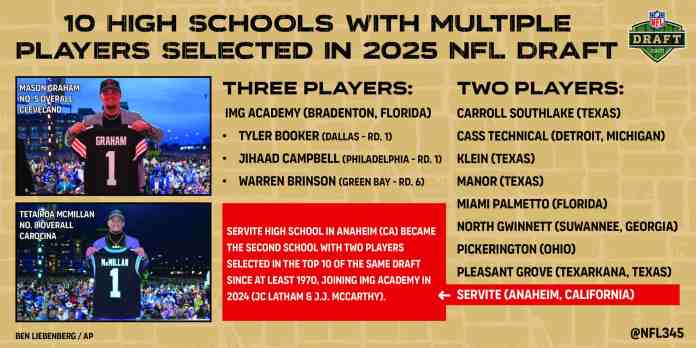
IMG Academy (Bradenton, Florida) led the way with three players selected, while nine high schools – Carroll Southlake (Texas), Cass Technical (Detroit, Michigan), Klein (Texas), Manor (Texas), Miami Palmetto (Florida), North Gwinnett (Suwannee, Georgia), Pickerington (Ohio), Pleasant Grove (Texarkana, Texas) and Servite (Anaheim, California) – each had two players selected.

Forty-one states and the District of Columbia each had at least one player drafted. Texas, with four of the 11 schools to produce multiple drafted players, led all states with 37 players selected in the 2025 NFL Draft, followed by Florida (26 players), Georgia (22), California (16), Louisiana (10) and Virginia (10).

Over the past eight NFL Drafts (2018-25), high schools from Texas (243 players) and Florida (242) have had the most players selected. Texas led all states with six first-round selections in the 2025 NFL Draft, including Cam Ward (No. 1 overall) and Ashton Jeanty (No. 6).

“Texas high school football is the best-of-the-best from the players to the coaches,” said Jeanty. “There is nothing like the game day atmosphere!”

IMG Academy is the only school to have multiple players drafted in each of the past seven years and has produced a first-round selection for the sixth-consecutive draft (Tyler Booker and Jihaad Campbell in 2025, JC Latham and J.J. McCarthy in 2024, Nolan Smith in 2023, Evan Neal in 2022, Greg Newsome in 2021 and Cesar Ruiz in 2020).

Servite, with Mason Graham (No. 5 overall) and Tetairoa McMillan (No. 8), became the second high school to have two players selected in the top 10 of the same NFL Draft since at least 1970, joining IMG Academy in 2024 (Latham and McCarthy).

”T Mac [Tetairoa McMillan] is one of my best friends and it’s exciting to see him and I make our dreams come true and get drafted in the first round,” said Graham. “Servite brought us a tight brotherhood with its rich history and I’m looking forward to the next group of young guys to come out of there and accomplish the same goals we just did.”

For the 19th time in the past 20 seasons, at least one player who attended high school outside of the United States was selected in the NFL Draft. The 2025 players selected: Denver Broncos P Jeremy Crawshaw (Emu Plains, New South Wales, Australia – 6th round) and San Francisco 49ers QB Kurtis Rourke (Oakville, Ontario, Canada – 7th round).

The breakdown of the 10 high schools that had multiple players drafted by NFL clubs:

HIGH SCHOOL  TOTAL PLAYERS (NFL TEAM/ROUND)
IMG Academy (Bradenton, Florida) 3 Tyler Booker (Dallas/1); Jihaad Campbell (Philadelphia/1);
Warren Brinson (Green Bay/6)
Carroll Southlake (Texas) 2 R.J. Mickens (L.A. Chargers/6); Quinn Ewers (Miami/7)
Cass Technical (Detroit, Michigan) 2 Deone Walker (Buffalo/4); Kobe King (Minnesota/6)
Klein (Texas) 2 Matthew Golden (Green Bay/1); Jaydon Blue (Dallas/5)
Manor (Texas) 2 Princely Umanmielen (Carolina/3); Tahj Brooks (Cincinnati/6)
Miami Palmetto (Florida) 2 Jason Marshall (Miami/5); Brashard Smith (Kansas City/7)
North Gwinnett (Suwannee, Georgia) 2 Barrett Carter (Cincinnati/4); Jordan Hancock (Buffalo/5)
Pickerington (Ohio) 2 Jack Sawyer (Pittsburgh/4); Ty Hamilton (L.A. Rams/5)
Pleasant Grove (Texarkana, Texas) 2 Landon Jackson (Buffalo/3); Nick Martin (San Francisco/3)
Servite (Anaheim, California) 2 Mason Graham (Cleveland/1); Tetairoa McMillan (Carolina/1)

HIGH SCHOOL STATES WITH MOST NFL PLAYERS DRAFTED IN 2025 PER CAPITA

STATE POPULATION * NFL PLAYERS NFL PLAYERS PER CAPITA
Louisiana 4,657,757 10 1 NFL player per 465,776 people
Georgia 10,711,908 22 1 NFL player per 486,905 people
Montana 1,084,225 2 1 NFL player per 542,113 people
Alabama 5,024,279 9 1 NFL player per 558,253 people
South Carolina 5,118,425 9 1 NFL player per 568,714 people
UNITED STATES 331,449,281 255 1 NFL player per 1,299,801 people
* Based on most recent U.S. Census Data (2020)

STATE BREAKDOWN BY HIGH SCHOOL

STATE PLAYERS DRAFTED STATE PLAYERS DRAFTED
Texas 37 Colorado 3
Florida 26 Indiana 3
Georgia 22 Mississippi 3
California 16 Tennessee 3
Louisiana 10 Utah 3
Virginia 10 Hawaii 2
Alabama 9 Montana 2
Michigan 9 Nebraska 2
South Carolina 9 Arkansas 1
Maryland 8 District of Columbia 1
North Carolina 8 Idaho 1
Ohio 7 Kentucky 1
Massachusetts 6 Nevada 1
New Jersey 6 New Mexico 1
Arizona 5 New York 1
Kansas 5 Oklahoma 1
Pennsylvania 5 Oregon 1
Washington 5 South Dakota 1
Illinois 4 West Virginia 1
Iowa 4
Minnesota 4 International 2
Missouri 4    
Wisconsin 4 TOTAL 257

For the full list of drafted players by high school state, click here.

Contact: Sam Drexler, NFL; Sam.Drexler@NFL.com

For more from NFL Communications, visit  media.nfl.com


Transfer Portal Shakes up College Football

0
Photo Cred: Linkedin

The spring college football transfer portal was opened from April 16 and will close on April 25. Within the first 24 hours, over 3,000 players had already entered the portal, signaling the start of what’s expected to be a chaotic and transformative week for programs across the country. While some players had publicly announced their intention to transfer before the window opened, schools were not permitted to have formal conversations with them until this period began.

The transfer portal has rapidly become one of the most pivotal elements of roster building in college football. What was initially designed to help student-athletes find better playing opportunities or more suitable environments has evolved into something entirely different. Now, in many cases, the primary consideration for transferring isn’t just playing time—it’s compensation. NIL, or Name, Image, and Likeness, has completely reshaped how players and programs approach the process.

While there are still many athletes who enter the portal for traditional reasons—like finding a better system fit, a new coaching staff, or proximity to home—the reality is that NIL money has become a driving force, particularly at the upper levels of the FBS. The portal is no longer just about football; it’s about market value, brand deals, and who can offer the biggest financial package.

The conversation around NIL exploded even more due to a high-profile situation at Tennessee involving quarterback Nico Iamaleava. According to reports, Nico asked for $4 million to remain with the Volunteers—a steep ask considering he was already earning over $2 million annually through Tennessee’s NIL collective. When the school refused to meet his demands, Nico skipped practice, and shortly after, head coach Josh Heupel announced that the team would be moving forward without him. He eventually transferred to UCLA.

Why Tennessee teammates mobbed Nico Iamaleava after his first TD pass

Photo Cred: USA Today

For a program like Tennessee, which reached the 12-team College Football Playoff last season and had high expectations going into 2025, losing a starting quarterback this late in the offseason is a huge blow. Yet, from the program’s perspective, standing firm was a significant statement. In a landscape where player leverage is at an all-time high, Tennessee drew a line—refusing to cave to what many see as an unreasonable demand.

As for Nico, there’s no doubt he’s one of the most talented and highly sought-after quarterbacks now available in the portal. But his reputation may be taking just as big of a hit as Tennessee’s depth chart. Skipping practice over NIL negotiations is a tactic more familiar to professional leagues than college football, and it raises concerns about locker room chemistry and leadership. Coaches across the country are surely taking notice, not just of his price tag, but of how this situation unfolded.

From a practical standpoint, it’s also a tough time for a top-tier program to bring in a quarterback with such expectations. Spring practices are already underway or winding down, and playbooks are being installed. A new quarterback would need to hit the ground running—learning the offense, building trust with teammates, and adjusting to a new culture—all under the pressure of justifying a multi-million-dollar investment. On top of that, many schools have already committed their NIL budgets for the year. Not every program has boosters ready to drop millions on short notice.

This whole situation underscores how far NIL has drifted from its original intent. NIL—short for name, image, and likeness—was created to give athletes the ability to monetize their personal brand. The idea was to let them earn money from endorsement deals, social media influence, or appearances in video games and advertising campaigns. But it’s morphed into something else entirely.

Why Tennessee teammates mobbed Nico Iamaleava after his first TD pass

What we’re seeing now is not NIL in its purest form—it’s a high-stakes auction. Wealthy donors and booster collectives are essentially negotiating salaries on behalf of schools, even though these transactions aren’t technically coming from the institutions themselves. That’s created a system where the highest bidder wins, and where loyalty, development, and team culture often take a back seat to the size of the paycheck.

There’s nothing inherently wrong with players wanting to benefit from the billions generated by college football. They absolutely should. But when $2 million isn’t enough for a 20-year-old to stay at a school, it’s clear that the system needs structure, transparency, and boundaries. Right now, it feels like the wild west—and the consequences are starting to show.

Russell Wilson Signing- What it Means for the Giants Draft

Photo Cred: Giants

The New York Giants took a major step toward solidifying their quarterback situation this offseason, signing Russell Wilson to a one-year deal worth $10.5 million, with incentives that could raise the total to $21 million. They also added Jameis Winston on a two-year, $8 million contract, giving the team a seasoned trio of quarterbacks as they approach a crucial 2025 NFL Draft. These additions bring immediate stability and, just as importantly, offer the franchise valuable flexibility in how they build the roster for both the present and the future.

Russell Wilson landing spots: Steelers, Giants among best fits

Photo Cred: USA Today

General Manager Joe Schoen emphasized the importance of entering the draft from a position of strength rather than desperation:

“Since I’ve been here, we’ve tried to set it up on draft day that we could go play a game [that day]. I feel like we’re there now. That way you don’t get backed into a corner or force yourself to do anything,” Schoen told Giants.com.

That strategy is paying dividends. The additions of Wilson and Winston provide veteran leadership and competence at the most important position in football, ensuring that the Giants can approach the draft with options rather than needs.

What This Means for the Giants on Draft Day

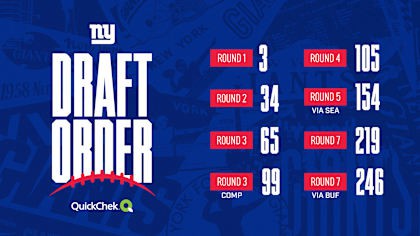
Holding the third overall pick, the Giants are in an enviable position. The veteran signings don’t eliminate the possibility of drafting a quarterback—they simply remove the pressure to start one right away. Instead, a young signal-caller could develop at the right pace, learning behind two quarterbacks who have each experienced both highs and lows in the NFL. A move up to the No. 1 overall pick appears increasingly unlikely, with the Tennessee Titans reportedly locked in on Washington State’s Cam Ward.

Meanwhile, the Cleveland Browns—owners of the second pick—are widely believed to be targeting two-way superstar Travis Hunter. That leaves New York at No. 3, facing a pivotal decision between two paths: draft their quarterback of the future in Shedeur Sanders or take the best player available (BPA) on their board. Sanders brings the mental toughness, arm talent, and leadership teams covet in a franchise quarterback. He showed resilience at Colorado, performing admirably despite constant pressure and a lackluster offensive line.

His experience operating under duress and his poise in big moments make him an intriguing prospect, especially if given time to grow. But the Giants could also opt to load up elsewhere. If Hunter is available, he presents a rare opportunity to draft a uniquely gifted two-way player who could start immediately on defense and contribute in a hybrid offensive role. If Hunter is off the board, linebacker Abdul Carter may be the top option—a blue-chip edge defender with elite traits who could transform the Giants’ defense into one of the most feared units in the league.

The Ideal Draft Scenario

In a perfect world, Travis Hunter is available at No. 3. He would start instantly at cornerback opposite newly signed Paulson Adebo and provide added dynamism on offense alongside breakout rookie wide receiver Malik Nabers. Hunter’s elite athleticism, positional versatility, and football instincts make him a true unicorn—a player with All-Pro potential on both sides of the ball.

If the Browns take Hunter at No. 2, the Giants’ pivot to Abdul Carter would be seamless. A front seven featuring Dexter Lawrence, Brian Burns, Kayvon Thibodeaux, Chauncey Gholston, and Carter would be among the league’s most disruptive. This would mark a return to the kind of bruising, high-energy defense that defined the Giants’ Super Bowl-winning teams in 2007 and 2011.

2025 NFL mock draft: Cam Ward, Travis Hunter, Abdul Carter and then?

Photo Cred: USA Today

Later in the draft, New York could look to add a developmental quarterback such as Jaxson Dart or Jalen Milroe in the late first or second round. Dart, in particular, has the physical tools and toughness to thrive in the NFL. With a solid arm, above-average mobility, and a history of playing in a pro-style system at Ole Miss—like Giants legend Eli Manning—he could be a smart, low-risk investment. Under the guidance of Wilson and Winston, a player like Dart could flourish without the pressure of early expectations.

Russell Wilson’s Impact Goes Beyond the Stats

Though Wilson may no longer be the dynamic dual-threat who led the Seahawks to a Super Bowl, he remains one of the league’s most prepared and experienced quarterbacks. Last season in Pittsburgh, he showed signs of a resurgence, throwing 16 touchdowns in just 11 games. His ability to extend plays, deliver a deep ball, and manage the game remains valuable.

Perhaps more telling than his stats was Wilson’s opening press conference with the Giants. He spoke extensively and insightfully about the team’s current roster, highlighting his film study and preparedness. That level of engagement and professionalism sets a tone for the locker room. His presence not only boosts the quarterback room, but also elevates the organization’s overall standard.

Balancing the Present With the Future

Many Giants fans were understandably frustrated when a late-season victory over the Colts cost them the No. 1 overall pick. But in the months since, the front office has recalibrated and executed a plan that brings both immediate promise and long-term potential. The Giants now have the freedom to stay put at No. 3 and take a player who fits their vision—be it a quarterback like Sanders, a game-changer like Hunter, or a defensive centerpiece like Carter.

And if the team decides to wait on a quarterback until 2026, when the class is expected to be deeper and stronger, they’re equipped to do so. That’s the value of flexibility: it gives a team the chance to build strategically, not reactively. The Giants have done something rare this offseason.

They’ve improved the roster in meaningful ways, provided clarity at the quarterback position, and given themselves options for the draft without mortgaging their future. For the first time in years, fans can look ahead with real optimism—not just for the upcoming season, but for what lies beyond. The future is no longer just a concept. For Big Blue, it’s finally coming into focus.

Colorado Retire Shedeur Sanders & Travis Hunter’s Numbers

0
Photo Cred: USA Today

The Colorado Buffaloes football team will hold their annual spring game with a special celebration that marks a historic moment for the program. The team will retire the jersey numbers of two of its most iconic players from the past two seasons: Shedeur Sanders (No. 2) and Travis Hunter (No. 12). With this honor, they become just the fifth and sixth players in Colorado football history to have their numbers permanently retired. They now join an elite group of Buffaloes legends that includes Byron White (No. 24), Joe Romig (No. 67), Bobby Anderson (No. 11), and Rashaan Salaam (No. 19).

Travis Hunter Gets His Jersey Retired At Colorado (Spring Game Vlog)

Photo Cred: Youtube

In just two seasons, Sanders and Hunter left an unforgettable mark on the university—both on and off the field. After following head coach Deion Sanders from Jackson State to Boulder, the duo instantly became the faces of a new era for Colorado football. Their first season in 2023 didn’t produce a winning record, as the Buffaloes finished 4-8, but the turnaround from a dismal 1-11 campaign the year prior was evident. More importantly, their arrival sparked a wave of national interest in the program. Celebrities, athletes, and entertainers filled the sidelines at home games, and the buzz around the team reached new heights when ESPN’s College GameDay made a stop in Boulder.

It was clear that Colorado football was once again in the spotlight. In 2024, that attention turned into on-field success. The Buffaloes went 9-4, earned a spot in the Alamo Bowl, and showed they could compete at a high level. Travis Hunter had one of the most remarkable seasons in college football history.

As a true two-way player, he not only became the first in decades to win the Heisman Trophy, but also captured several other major national awards. He was named the nation’s top wide receiver with the Biletnikoff Award, recognized as the top defensive player with both the Lott IMPACT Trophy and Bednarik Award, honored with the Walter Camp Award for national player of the year, and celebrated for his versatility with the Paul Hornung Award. His ability to dominate on both sides of the ball made him a truly generational talent.

Shedeur Sanders, meanwhile, proved himself to be one of the top quarterbacks in the country. He was awarded the Johnny Unitas Golden Arm Award, given to the best upperclassman quarterback in the nation, and rewrote the Colorado record books in the process. Sanders set school records in completion percentage and passing touchdowns, displaying both poise and precision throughout the season. His leadership, presence in the pocket, and ability to perform in big moments made him the heart of the Buffaloes’ offense.

Shedeur Sanders officially ruled out for Colorado's season finale at Utah

Thanks to their exceptional play, both Hunter and Sanders are projected as top-10 picks in the upcoming NFL Draft. Their impact at Jackson State and Colorado has already cemented their legacies at the college level, and now they look to carry that same success into the professional ranks. Their journey has been about more than just wins and statistics—it’s been about changing the culture, raising expectations, and showing what’s possible when talent meets opportunity. As their numbers are officially retired, the Buffaloes aren’t just honoring two extraordinary athletes—they’re celebrating a turning point in the program’s history.

Ohio State Buckeyes to Push for More Night Games

1
Photo Cred: USA Today

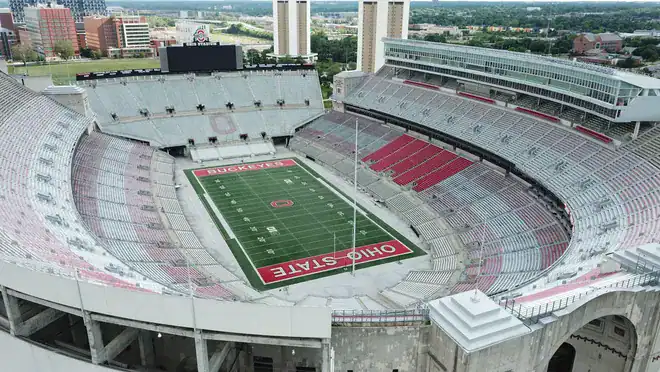
Ohio State Athletic Director Ross Bjork has announced that he is working closely with the school’s television partners to secure more primetime games for the Buckeyes in the future. The 2024 season was filled with noon kickoffs, largely tied to Fox’s Big Noon Kickoff pregame show, a trend that many fans and the program itself are hoping to change. In 2024, Ohio State played only three night games: one at home against Western Michigan and two on the road—at Oregon and at Michigan State.

Ohio State asks fans to 'Scarlet the Shoe' for Saturday's game against  Nebraska

Photo Cred: USA Today

Meanwhile, seven of their games kicked off at noon, including six straight to close out the season. That late stretch included two top-10 matchups against Penn State and Indiana, both of which were played under the midday sun rather than the stadium lights. As the Big Ten’s primary television rights holder, Fox has the first pick of games and kickoff times. CBS and NBC follow behind, making it difficult for non-Fox games to secure primetime slots. This setup is similar to the SEC’s agreement with ESPN, which also controls Big 12 and ACC broadcast rights.

The Big Ten and SEC have long competed as the nation’s top football conferences, and that rivalry now extends to their broadcast partners. Fox launched Big Noon Kickoff in 2019 as a counter to ESPN’s iconic College GameDay, which has aired since 1987. However, a major difference is that ESPN’s featured games often lead into primetime kickoffs, while Fox’s top matchups are aired at noon.

This strategy has paid off for Fox in terms of ratings, as avoiding direct competition with ESPN’s primetime slot has proven effective. However, it has come at a cost—especially for fans attending the games. Big-time college football matchups are meant to be played under the lights, with the day building toward the electric atmosphere of a night kickoff. That energy, especially when ranked teams are involved, is what sets college football apart.

Fox seems to be missing the mark by not capitalizing on the Big Ten’s massive fan bases. Ohio State is one of the most recognized universities in the world—its games would draw viewership regardless of the time slot. So why not create the best possible game-day experience for both fans at home and in the stadium?

The Buckeyes will open their 2025 season at home against Texas in a rematch of the Cotton Bowl—a game Ohio State won dramatically thanks to a late scoop-and-score by Jack Sawyer, which propelled them to the National Championship, where they defeated Notre Dame. It’s a perfect storyline to kick off the season, yet many fear that Big Noon Kickoff will once again anchor in Columbus, meaning another noon kickoff. Ross Bjork has publicly stated that he’s pushing for that game to be played at night.

Amway Coaches Poll: Changes in top five after losses by Penn State, TCU

Photo Cred: USA Today

Another marquee home matchup in 2025 will be against Penn State—a game that has frustratingly kicked off at noon for the past three seasons despite both programs consistently being ranked in the top 10. While Fox continues to prioritize what works best for their business, Bjork and the Buckeye faithful are hoping for change. More night games would enhance the in-stadium experience and reflect the high stakes and national significance of these matchups. The hope is that networks will begin to prioritize the fan experience alongside ratings. Until then, the battle for kickoff times remains a major talking point for programs like Ohio State.