Home Blog Page 269

Whole lotta Mariota: Can Marcus secure monster contract?

Marcus Mariotta / Nam Y. Huh (AP Photo)

The Tennessee Titans took a big step forward in 2017 by making the postseason and winning a playoff game. But, if the team is going to take the next step and become a serious contender in the American Football Conference (AFC) this year, new head coach Mike Vrabel needs a similar leap from fourth-year quarterback Marcus Mariota. After inheriting a dumpster fire in his first year, Mariota’s gone 18-14 as a starter, including last year’s playoffs. 

Going into his fourth season, Mariota remains a mystery. There have been plenty of positives, but now it’s time for Mariota to secure a monster contract and show he’s a top-tier quarterback. As the No.2 overall NFL draft pick, he displayed flashes of star power during his rookie year. The 2014 Heisman Trophy winner finished his 12-game, 2015 rookie year with 2,818 passing yards, 19 touchdowns and ten interceptions. Additionally, he rushed for 252 yards with two rushing touchdowns. 

He exploded on the scene in his second year, stepping up as a bona fide star. Mariota connected on 61% of his passes for 3,426 yards, 26 touchdowns and nine interceptions. Cutting down on turnovers was the biggest improvement he made, reducing fumbles despite playing three more games (15) in 2016.  

This past season, everything seemed primed for Mariota to establish himself as a franchise quarterback. However, he took several steps backwards in several aspects. Turnovers once again became a major problem for the talented performer. His completion percentage (62.0) and yardage total (3,232) were similar to 2016. But, with 13 TD passes and 15 interceptions, it’s hard to look past his faltering play, even with leading his team to the playoffs. His turnovers add up to 46 in 42 regular-season contests. That level of performance won’t do, even if making the playoffs. Both the quarterback, QB coach Pat O’Hara and new offensive coordinator Matt LaFleur certainly have work to do in this area, but Mariota remains positive. 

“It’s been great,” Mariota said. “Pat and Matt have been awesome. They’ve been tremendous in (continuing) to work fundamentals. At the same time, helping us learn the offense in a way that’s easy and just makes it so that everything is pretty smooth. I’ve got to give a lot of credit to them, I think they’ve done a great job so far. Again, as we progress forward there’s always going to be some bumps in the road, but I think these guys have done a great job of handling everything.” 

More encouraging news comes from the fact Mariota is reportedly finally fully healthy from his fractured right fibula. His athletic ability is back to Oregon form, freeing him to focus on fundamentals as he returns to 2016-2017 levels. Additionally, Vrabel is working Mariota into a new style of offense. So far this offseason, he’s spent time working with his wide receivers “off the clock” in an effort to become a better passer this season. Those stats, while leading the team to the playoffs again, should lead Mariota to the contract extension he desires. 

Law of the Jungle: Clemson Tigers still king of the ACC

0
Clemson 2017 Football Championship / Photo courtesy of: Chris O'Meara (APSI)

The Clemson Tigers possess one of the best defensive lines in the country and a solid back seven in the loaded Atlantic Coast Conference. Offensively, Clemson is littered with playmakers, with three, up-front starters returning to school. Senior Kelly Bryant returns, opening up fall camp as a starter, while freshman Trevor Lawrence looks to establish himself for playing time. Lawrence provides Clemson with more offensive punch as he has more downfield passing capability than last year’s offense. The Tigers are no strangers to the tough ACC schedule, and their competitors are fierce. The ACC is currently one of the best football conferences in the nation.  

Even so, Clemson is clearly the pick in the ACC and a top five football team coming into the season. The last few years, Clemson has posted a strong defense and their defensive side of the ball this year will be virtually unmatched. Clemson’s defensive line is going to be out of this world. 

While the defense will be stellar, there is a key player on the offensive side to watch. Regardless of whether Bryant or Lawrence is the starter, the Tigers are in fantastic shape in the wide receiver department. Deep threat Tee Higgins is the X-factor who could really put Clemson over the top. With Deon Cain and Ray-Ray McCloud leaving for pro careers, Higgins, who averaged 20.3 yards per reception last season, seeks to put fear in the hearts of DB’s and defensive coordinators. He just might lead the ACC in receiving yards. 

The Tigers might be the pick in the ACC, but a team in Florida may meet them in the 2018 ACC Championship Game to show us otherwise. The Tigers won’t face the Miami Hurricanes during the regular season, however the turnover-forcing defense will be the calling card of the Hurricanes once again, as nearly all their linebackers and secondary’s reappear for another year. That spells trouble if it’s the young freshmen taking snaps against Miami. And wide receiver Ahmmon Richards returns from injury, so their offense should be better this year. 

Willie Taggart / Photo courtesy of: Mark Wallheiser (APSI)

The biggest regular-season threat is the Florida State Seminoles. New coach Willie Taggart has put together a strong recruiting line accompanying their returning talent. Clemson plays at Tallahassee in October. Even if Florida State beats Clemson, its chances of going 7-1 in ACC play and winning the Atlantic Division are slim with road games at Louisville, North Carolina State and an opener against Virginia Tech. 

Clemson has won the ACC Championship and been selected for the college playoffs the last three years. With a little Dabo magic, stopping the Tigers from scoring will be hard. Moving the ball against this defense may be even harder. They might slip up once along the way, but a fourth, consecutive, postseason battle between Alabama and Clemson might be here before we know it. It’s college football’s version of the Cavs vs. the Warriors. 

Ruffled feathers: Eagles join list of teams to decline White House visit

Malcolm Jenkins protests with fist / Alex Brandon (AP photo)

President Trump “called-off” a scheduled, June 5 visit from the Philadelphia Eagles, champions of Super Bowl LII. Called off is quoted because it’s sort of like when an elementary school kid invites everyone in his or her class to their birthday party, discovers only a couple intend to come, then cancels the gala. Many of the Eagles said they would not participate in the visit, prompting Trump to host a patriotism event instead.  

Trump has been very outspoken about the NFL kneeling issue. He’s quoted as saying players who kneel during the playing of the national anthem should be “fired” or “suspended.” The New England Patriots did visit the White House after their Super Bowl victory in 2017. That could be due to the friendship between Trump and Patriots owner Robert Kraft. Several Patriots players did however, refuse, including Martellus Bennett and LeGarrette Blount. 

The President has blurred the lines between sports and politics since taking office 17 months ago. He has taken on the NFL over its national anthem protests, criticized NCAA athletes who did not thank him for coming to their aid and attacked NBA superstars on Twitter. 

Other notable teams that did accept Trump’s invitations are the 2017 Pittsburgh Penguins and 2017 Houston Astros. Although two Puerto Rican-born players, Carlos Beltran and Carlos Correa, were absent. The 2018 University of Alabama National College Football Championship team also visited the White House. While championship teams have visited the White House dating back at least 50 years, the decision to accept an invitation from Trump has become politically perilous. 

The Eagles appear to be a much closer team than most. Their locker room seems to be in as good of shape as any Super Bowl-winning team in recent years. It’s no secret they also have a few, very outspoken players on their team, including the notably silent Malcolm Jenkins. Jenkins recently held up signs in silence while being interviewed by multiple reporters. One of the signs simply said, “You’re not listening”. Others listed statistics for murdered and incarcerated African Americans. 

Fox News Channel stirred the controversy by airing video of Eagles players kneeling to pray several minutes before the anthem was played. In fact, no Eagle kneeled this entire year, although several did stand with raised fists in protest while the anthem was performed. The network was criticized by players such as Chris long who said, “Fox News used the faith of Christian men dishonestly to push an agenda. That wasn’t an “error”, but intentional and strategic.” Fox News later issued an apology. 

CNN dropped the media ball, too, after political analyst April Ryan was forced to backtrack on claims the President was “heckled and booed” at Tuesday’s White House event after it was reported the ridicule was, in fact, directed at a protester in the crowd. She quickly walked back those comments after learning a heckler in the crowd was asking the President questions, and as a result was booed. 

“The booes [sic] were for the heckler,” Ryan said in her tweet. She later deleted the tweet, citing “reporters on the south lawn” for misreporting the events. CNN’s Noah Gray said that Ryan’s tweet was not true. He later shared a picture of the man who was heckled by the crowd and escorted out. Despite her attempts to backtrack, Twitter users fired back at Ryan’s misreporting. 

It doesn’t appear the trend of teams not accepting the President’s offer to visit the White House will end any time soon, either. LeBron James was quoted as saying the Warriors or the Cavs wouldn’t accept an invitation no matter who won. LeBron was also very critical of Trump last year, calling him a “bum.” 

Turnabout is fair play: SEC changes its transfer rule

0

Recently, the Southeastern Conference meetings in Destin, Fla. made a big splash in the lives of college athlete transfers. In the past, players had to get a waiver from the school they’re transferring from to be eligible immediately. And, for the most part, no coach would sign that waiver; even if the student already received their degree. 

Recently, Nick Saban caught a lot of flak for not allowing graduate transfer center Brandon Kennedy to handover freely to either Tennessee or Auburn, who both appear to have interest in the graduate. Kennedy even unsuccessfully appealed to Alabama. That will no longer be the case. Graduate transfers can now freely transfer within the SEC without the all-encompassing, all-important waiver. 

Saban isn’t the only coach to block players like this, but he seems to be the one most in the news most for it. Last year, a defensive back named Maurice Smith wanted to transfer to Georgia to play for Kirby Smart, his former defensive coordinator. Saban balked, but outrage from the public eventually forced Alabama to sign the waiver and Smith was allowed to play immediately. 

Another rule change in the transfer process will directly affect the University of Florida Gators. Van Jefferson, the talented receiver from the University of Mississippi, can now play immediately for Florida. After struggling heavily last year, the Gators need all the help they can get on offense. The new change states a player can transfer freely within the conference without a waiver if his team is facing National Collegiate Athletic Association sanctions. 

Ole Miss faces a ban for the 2018 season after the NCAA penalized them for a large number of recruiting violations stemming from former coach Hugh Freeze. “The University of Mississippi lacked institutional control and fostered a culture of booster involvement in football recruiting according to a Division I committee of infractions panel,” is the statement cited in the NCAA’s report.  

This could continue to hurt Ole Miss if a few other players decide to transfer within the conference. There would have likely been more transfers had this rule been applied earlier. Ole Miss has already lost Jefferson to Florida and Shae Patterson (QB) to Michigan. Had this rule already been passed, it would have been interesting to see if Patterson would have transferred within the conference, too.  

Both of these rule changes actually seem like the right thing to do for student athletes, which is a rarity among the NCAA and SEC. The offseason could get very interesting now.  

Power in the present…

    0
    FX0F5K Clemson Head Coach Dabo Swinney during the Clemson Football Spring Game / Jacob Kupferman (CSM)

    Sports Gambling: The Noble Experiment II

    The Good, the Bad and the Ugly

    By now you have heard of the United States Supreme Court’s decision to allow individual States in the Union to pursue gambling legislation and regulatory schemes within their borders. The prospect for gambling in 49 States not named Nevada was made possible by the Court declaring that a 1992 law, the Professional and Amateur Sports Protection Act (PASPA), was unconstitutional. The 6-3 majority wrote in their opinion: “Congress can regulate sports gambling directly, but if it elects not to do so, each State is free to act on its own. Our job is to interpret the law Congress has enacted and decide whether it is consistent with the Constitution. PASPA is not.” Referring to New York v. United States, 505 U.S. 144 (1992), the Court reasoned that the States could not be commandeered to enforce a federal regulation.

    The Good

    The rewards are straightforward: the potential for added revenue with a reduction in the black and gray gambling markets. Legalized gambling also means more business creation, jobs, related opportunities and work for lawyers.

    Specifically, professional sports leagues stand to gain by charging a premium for copyrightable and trademarkable content, namely its players, brands, and potentially its statistics when analyzed and formulated in a specific way. If the gambling houses want to play it smart, they will include the professional sports leagues’ senior leadership and the players associations’ to grow the gambling programs together, to avoid getting sued, with the players, teams, leagues, gambling houses, casinos and bettors participating in the profits. Of course, all of this assumes a regulatory scheme is in place to protect consumers and all parties involved before the gambling begins.

    In addition, it will be interesting to see if sports broadcasting companies (NBC, ABC, Fox, TNT, etc.) and technology distribution platforms/companies (Verizon, AT&T, Hulu, Amazon, Facebook, Apple, etc.) seek a piece of the pie since they are the ones broadcasting and distributing the copyrightable and trademarkable sports content.

    The Bad

    There is roughly a 5 percent margin for profit in gambling. A profit for new partners involved in the process, namely the leagues and the players associations, requires that the profit come from somewhere. An increase in profit assumes that more people will gamble or that current gamblers will be brought out of the darkness (e.g., illegal online gambling) and into the light of legalized gambling. It also assumes that any regulatory scheme will pass the “cost of doing business” (i.e., gambling fees and taxes) onto the consumer so that the profit margins are maintained.

    The Ugly

    Rhetorically speaking, was PASPA the second iteration of the original noble experiment, the prohibition against alcohol? Did PASPA seek to regulate moral behavior? Will there now be an explosion in sports betting as there was after prohibition, the first noble experiment? What are the potential consequences of legalized gambling in the United States?

    First, imagine navigating the federal and state regulatory schemes as a participant, manager, owner, or lawyer in the gambling space, interpreting both federal and state law. For example, leaders in the United States Congress have already discussed presenting a federal regulatory scheme for gambling. Moreover, each State will also have to have its own law on the books before proceeding with state-sponsored or legal gambling. The process and implementation alone will be fascinating to follow. Hopefully, Congress and the State’s provide clear vision as to what legal gambling is allowed and where so as to avoid confusion. A regulation is after all only as good as its enforcement and interpretation.

    Second, collegiate and professional athletes stand to be in a precarious situation. Unfortunately, baseball legend Peter Rose learned the hard way with illegal sports gambling. Since the door is now open through legalized gambling, however, a regulatory scheme at both the legislative (federal and state) and administrative (sports leagues) levels will be important to make sure that the integrity of sport and its participants are maintained. To that point, any gambling regulatory scheme would likely include a provision that direct participants in sports not be allowed to place a sports bet to avoid the appearance of impropriety.

    Third, is more gambling a good idea for a society mired in debt? It means more revenues for States and the federal government, but what about the consumers? Is more regulation good for business? However, again, back to regulating moral behavior through a noble experiment law. In the end, it should be celebrated that legislation outlawing something without the federal government entering the space before or since was at the least awkward, and at its worst, unconstitutional, as the U.S. Supreme Court held.

    Congress and the States will now get a second bite at the apple to set the course for legal sports gambling in America.

    The West’s Top Performers: Pitchers, Part 2

    0

    This is the final part of our two part series. Last week we discussed the hitters. This week we are looking at the ten best pitchers in the National League (“NL”) and American League (“AL”) West Divisions. In alphabetical order, by team. 


    Patrick Corbin, SP, Arizona Diamondbacks, NL West 

    4 wins, no losses, a 2.12 earned run average (“ERA”), 13 walks (base on balls/“BB”), 67 strikeouts (“SO”), a .167 batting average against (“AVG”) and a 0.82 WHIP (walks plus hits per inning pitched/”WHIP”) through 51 innings pitched (“IP”) is impressive. Closer Brad Boxberger and 8th inning set-up man Archie Bradley have been equally impressive for the first place Diamondbacks. Zach Greinke’s 53:6 SO/BB ratio is also stellar. All around, the Diamondbacks’ pitching has been great through April and parts of May for the 2018 season. Corbin is also a free agent after this season.  

    Adam Ottavino, RP, Colorado Rockies, NL West 

    3 wins, 1 save, (for a non-closer, which is Wade Davis’s job), a 1.23 ERA, 9 holds, 9 BB, 38 SO, a .087 AVG and a 0.68 WHIP through 22 IP. The 6’5 205 lbs. 32 year-old is a free agent after the 2018 season and was a 1st round draft pick in 2006 out of Northwestern. His home and away (outside Coors Field) splits are equally impressive and should he continue at this pace he will help his team win and cash in on a large contract for 2019. 

    The Entire Starting Pitching Staff, Houston Astros, AL West 

    The entire Astros starting pitching staff could be inserted here and possibly select members of their bullpen, but if we have to be very selective, it would be a three-way tie between Justin Verlander, Gerrit Cole and Charlie Morton, in that order. When Dallas Keuchel and Lance McCullers, Jr. are your fourth and fifth best starting pitchers in the rotation, respectively by statistics, you know the team is performing at an elite level. The numbers: The 35-year-old Verlander has a 1.21 ERA (best of this team’s starting pitchers), 4 wins against 2 loses, 12 BB, 77 SO, a .146 AVG and a 0.97 WHIP through 59.2 IP (tops this list and a team best). Cole, the youngest of this trio at 27, has a 1.43 ERA, 4 wins, 12 BB, 86 SO (team best), a .155 AVG and a 0.74 WHIP through 56.2 IP. The 34-year-old Morton has a 2.03 ERA, 5 wins and no losses, 17 BB, 62 SO, a .175 AVG and a 0.97 WHIP through 48.2 IP. Morton is a free agent after the 2018 season, whereas Verlander and Cole will enter the free agent marking after the 2019 season. 

    Shohei Ohtani, SP (and batting cleanup), Los Angeles Angels of Anaheim, AL West   

    Tyler Skaggs has been great this year, but when you measure his statistics against Ohtani’s, you realize that Ohtani’s pitching statistics are a little better and he hits cleanup on the days that he does not pitch (or the days before and after that he pitches). We spoke about the potential greatness of the 23-year-old Ohtani previously, but as for now, the numbers: a 3.58 ERA, 3 wins against 1 loss, 13 BB, 43 SO, a .198 AVG and a 1.10 WHIP through 32.2 IP. Did we mention that he hits cleanup for the Angels offense as well? 

    Walker Buehler, SP, Los Angeles Dodgers, NL West  

    Normally, Clayton Kershaw would top this list, and he has been equally the perfectionist this year as in years past, but he is currently on the disabled list (with half of the Dodgers starting lineup and pitching staff) and only active players could be selected. That being said, the 23-year-old Kentuckian out of Vanderbilt University is an absolute stud and looks like the next Orel Hershiser, if not with more upside, should he stay healthy after Tommy John surgery. Through 22 IP, he has a 1.64 ERA, two wins, 27 SO against 7 walks, a 1.00 WHIP and a .190 AVG. If he keeps this up, Ohtani and Buehler may be the respective Rookies of the Year for each league, and the Dodgers third straight player selection. 

    Sean Manaea, SP, Oakland Athletics, AL West 

    Although closer Blake Treinen has been stellar this year, Manaea has a no-hitter under his belt this season, which was against a well-playing Boston Red Sox team. The numbers: 55.1 IP (third best behind Verlander and Cole), 7 BB, 45 SO, 4 wins against 4 losses, a 0.72 WHIP, 2.11 ERA and .170 AVG. 

    Brad Hand, RP, San Diego Padres, NL West 

    While Tyson Ross and Joey Lucchesi have been exceptional this year, closer Brad Hand, has the upper hand, pun intended. In his third season in San Diego, Hand has been a model of consistency. This year’s numbers stack up to the past two through this time of the season: 20.2 IP, 10 BB, 33 SO, 1.11 WHIP, 2.61 ERA, a .170 AVG and 11 saves. If the Padres are struggling, look for Hand to be a significant trade piece to a contending team looking for bullpen help.   

    Back of the Bullpen, San Francisco Giants, NL West 

    Both closer Hunter Strickland and set-up man Tony Watson have been great this year. Johnny Cueto has been great too (0.84 ERA through 32 IP), but he is on the disabled list and therefore could not be considered for this list. The two relievers could be twins, statistically speaking: 17-17.2 IP, 5 BB, 19 SO, 1.02-1.18 WHIP, 2.55-2.65 ERA, .197-.238 AVG, with 7 holds for Watson and 8 saves for Strickland (although he also has 2 blown saves). 

    Edwin Diaz and James Paxton, Seattle Mariners, AL West  

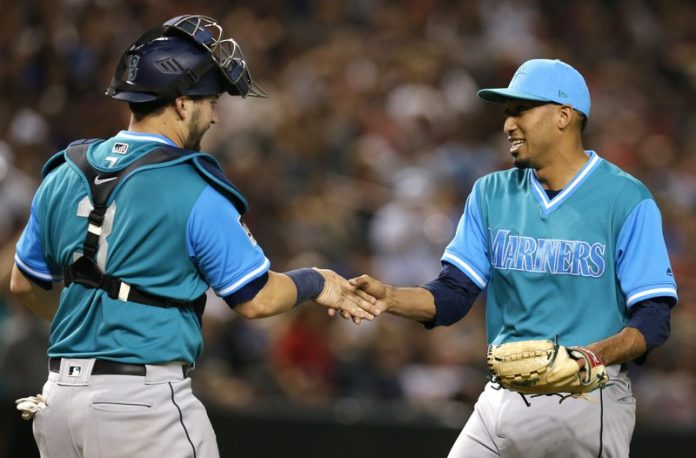
    Diaz and Paxton have been studs this year, especially Diaz.  Diaz has 19.1 IP, 9 BB, 34 SO, a 0.78 WHIP, a 1.86 ERA and a .094 AVG, with 13 saves (tops this list) and 1 blown save. Paxton has logged 53.2 IP, 19 BB, 71 SO, 2 wins, a 1.12 WHIP, a 3.52 ERA and a .206 AVG. Until Félix Hernández steadies the ship, the aforementioned have been the pitching staff anchors. 

    Bartolo Colon, Texas Rangers, AL West 

    You either laughed or searched the nearest Wikipedia page when you saw Bartolo Colon’s name here, but the stats do not lie. Cole Hamels has been great and will be Cole Hamels, but Colon, 44, is nearly ten years older than the next youngest person on this list (Justin Verlander, 35). He encroaches Jamie Moyer’s and Jesse Orosco’s records daily, who pitched until they were 49 and 46, respectively. Colon also has a better ERA than Hamels (3.48 to 3.32), and he brings 43.1 IP, 3 wins (against 2 loses), 4 BB, 29 SO, a 0.90 WHIP and a .223 AVG. His success has obviously helped his team, while reliever Jose Leclerc has been even better. The 24-year-old is 20 years younger than Colon and brings 13.1 IP, 2 holds, 6 BB, 18 SO, a 0.75 WHIP, a 2.03 ERA and a .093 AVG. 

    For now, that concludes our “Best of the West” series. Back next week on a new topic. 
    The West’s Top Performers: Hitters, Part 1

    0

    This is part one of a two-part series. Next week, we will look at the ten best pitchers in the National League (“NL”) and American League (“AL”) West Divisions. This week, we stay in those Divisions, but we are looking at the ten best hitters, statistically speaking. In alphabetical order, by team:


    A.J. Pollock, CF, Arizona Diamondbacks, NL West

    It is fair to say that Pollock is back after an injury-led 2017. His 10 home runs (“HR”), 29 runs batted in (“RBI”), 8 stolen bases (“SB”), .306 batting average (“AVG”), .362 on-base percentage (“OBP”), and 1.032 on-base plus slugging percentage (“OPS”) are tops for his team and rival some of the best hitters in baseball right now. He is the spark plug to the Diamondbacks’ offense.

    Nolan Arenado, 3B, Colorado Rockies, NL West

    Arenado and his teammate Charlie Blackmon were close, but Arenado just edges him out with 34 hits, 8 HR, 21 RBI, 1 SB, .315 AVG, .409 OBP, and 1.021 OPS. Arenado’s splits are impressive as well since he has more HR’s and RBI’s on the road versus at home in the Rockies, but his batting average has a 200-point difference (.439 at home, .239 on the road). Arenado, Blackmon, and Trevor Story lead this offense.

    Carlos Correa, SS, Houston Astros, AL West

    Correa’s teammate, José Altuve, has a slightly better AVG and OBP, but Correa as the shortstop edges out Altuve with his power. Correa has 38 hits, 5 HR, 25 RBI, 2 SB, .299 AVG, .369 OBP, and an .881 OPS. Correa is the emotional and statistical leader of this star-studded line-up.

    Mike Trout, CF, Los Angeles Angels of Anaheim, AL West  

    Mike, Trout. He leads his team and the league in many stats, and he has been doing it every year since his first full season in 2012. He has 42 hits, 12 HR (tops this list), 24 RBI, 6 SB (tops this list), .336 AVG, .458 OBP (tops this list), and a 1.178 OPS (tops this list). Need much more be said? He our era’s version of a healthy Mickey Mantle, without being a switch-hitter.

    Yasmani Grandal, C, Los Angeles Dodgers, NL West 

    Grandal is about the only thing not injured or going wrong for the Dodgers right now. Manager Dave Roberts said that without Grandal he does not know where the team would be. Grandal is a catcher and sometimes first baseman, who is a free agent at the end of the 2018 season. His stat line is impressive: 28 hits, 4 HR, 21 RBI, .272 AVG, .372 OBP, and a .848 OPS. His .272 AVG is his highest since his rookie season.

    Jed Lowrie, 2B, Oakland Athletics, AL West

    At age 34, Lowrie is the oldest hitter on this list, but his early season returns have been great for the A’s. Like Grandal, he is also a free agent after the 2018 season and had another stellar year last year. However, Lowrie already has half or more than half his 2017 HR and RBI totals this year through a month a half. His stats are as follows: 48 hits (tops this list), 8 HR, 31 RBI (tops this list), .353 AVG (tops this list), .405 OBP, and a 1.008 OPS.

    Christian Villanueva, 3B, San Diego Padres, NL West

    Having a breakout year, his 26 hits, 9 HR, 20 RBI, 1 SB, .265 AVG (lowest on this list), .351 OBP, and .943 OPS are tops for the Padres.

    Brandon Belt, 1B, San Francisco Giants, NL West

    Signed through the 2021 season, Belt and his new teammates, Evan Longoria and Andrew McCutchen, are providing a significant source of the team’s offense this year. Belt has 31 hits, 6 HR, 17 RBI, 1 SB, .298 AVG, .422 OBP (second on this list behind Trout), and a .970 OPS.

    Mitch Haniger, RF, Seattle Mariners, AL West 

    Mitch who? He was a part of the Jean Segura trade with the Diamondbacks. His stats do not lie: 35 hits, 10 HR, 27 RBI, 1 SB, .297 AVG, .380 OBP, a 1.007 OPS, and a significant reason why the Mariners are one of four winning teams in the AL West right now, with the team currently in third place behind the Angels and the Astros.  He is this year’s version of the Dodger’s Chris Taylor. This one’s for you, Jerry Dipoto.

    Nomar Mazara, SS, Texas Rangers, AL West 

    The second youngest hitter on this list behind Carlos Correa (by half a year), which says a lot considering how much Correa, and Trout (26 years old), have accomplished for being so young.  Mazara is a 6’4 stud in his third year having hit a total of 47 HR and 188 RBI in his brief career to date.  Joey Gallo on his team and across the diamond is bigger and stronger, but Mazara has the better batter’s eye, at least according to batting average. His stats: 37 hits, 7 HR, 23 RBI, .278 AVG, .333 OBP, and an .815 OPS. An impressive young hitter.

    Back next week with the pitchers.

    Where will your favorite sports team play next?

    The Jacksonville-London Jaguars, Montreal Expos, Mexico City Montañas and Portland Greens might know!


    International sports expansion is upon us 

    The Jaguars got married and took a second last name in London, baseball is back in French-speaking Canada, the Mexico City Montañas fight high altitude baseballs, but not in the Rockies, and the Portland Greens have beer and “going green” night. Despite this author making up those team names, they might be the headlines on your favorite sports website come 2019 and beyond.

    The NFL’s Jacksonville Jaquars owner Shahid Khan recently placed a bid for Wembley Stadium in London for $1 billion. He wants to host the Super Bowl and the World Cup at the stadium. Khan also owns Fulham F.C. in London, part of the English Premier League.

    The MLB’s Boston Red Sox owner John Henry also owns Liverpool F.C. of the English Premier League.

    The NFL’s Los Angeles Rams owner Stan Kroenke also owns Arsenal F.C. of the English Premier League.

    The NFL’s Tampa Bay Buccaneers owners Avie, Bryan, and Joel Glazer also own Manchester United of the English Premier League.

    One only need to look at the lists of America’s Richest Sports Team Owners 2017 and The World’s Richest Sports Team Owners 2018 via Forbes to see that sports team owners have money and that money is based both here in the United States and abroad.

    What does this mean for the future of sports in America? It means that the move to go international is upon us. Over the past five to ten years, Major League Baseball, the National Basketball Association, and the National Football League have all had teams in their leagues play in games overseas. The matches have been preseason games for the NBA, but the NFL and the MLB have played both preseason and in-season games in foreign markets. The NFL has played in London (the Jaquars multiple times), while MLB teams have played in San Juan, Puerto Rico, Monterrey, Mexico, Sydney, Australia, and Tokyo, Japan. The MLB also has the World Baseball Classic, now in preparation for its fifth iteration in 2022.

    If money is a driving factor in moving sports overseas, the Indian Premier League (cricket) currently has the eighth largest sports television broadcast deal in the world, worth more in dollars than the National Hockey League at $510 million annually. The deal is actual more valuable than stated because its term is for more dollars over a shorter period of time (2018-2022) versus other major sports that generally go 6-10 years in length. This shorter window allows the IPL to exploit their rights again as a free agent would when hitting the open market. One thing to note, broadcast rights always go up, never down.

    If viewers are a driving factor, despite having the largest sports television deals and valuable sports franchises, more people reside outside of the United States and the United Kingdom than do in it. These are markets full of anxious fans possibly waiting for content to reach them. For example, 2.7 billion people live in India and China alone, versus the 391 million people living in the USA and the UK. The distribution channels are already here, will your international city be the next to host a sports franchise? It is possible that expansion into Canada, Mexico, and the other parts of the United States are likely.

    Will “ShoTime” follow “The Great Bambino” into the batter’s box?

    0

    Shohei Ohtani, the Los Angeles Angels of Anaheim’s 23-year-old pitching and hitting phenom, is not the first athlete to woo the American public. Babe Ruth also once captured America’s collective hearts when he burst onto the scene for 14 years in the 20th century. In terms of the rules, the game of baseball has not changed much and because of those rules, Shoehei “ShoTime” Ohtani may soon be following Babe “The Great Bambino” Ruth into the batter’s box and off the pitching mound, or vice versa.  


    During Ohtani’s start on April 17, he was pulled from the mound after two innings due to of a reoccurring blister problem he says often happened in Japan, but he was able to make his next start. True to form, it was announced Sunday Ohtani would make his next scheduled start in Houston against their division rival, the Astros, on April 24. More concerning, however, might be the stressed ligament in his pitching arm elbow that was leaked during the offseason as Ohtani and his representation were seeking team offers. Whether the ligament is a similar issue like the one Los Angeles Dodgers Kenta Maeda has that’s workable, remains to be seen.  

    Ohtani is a once-in-a-lifetime talent, yet fans, experts and teams are having a hard time making the comparison to another famous player because it’s so rare. Bo Jackson and Deion Sanders wooed us because they played two sports really well. Arguably, their careers also ended early in one sport because they played two sports. Babe Ruth was one of the greatest pitchers in baseball before picking one side of the game (hitting vs. pitching). What will be interesting to watch in the coming months and years is if Ohtani’s body can survive the 162-game season playing both sides of the ball. As fans, we all hope he can and capture the collective American heart while accomplishing it. 

    On the other hand, history tells us another thing. From 1914-1919, Babe Ruth pitched and hit. Interestingly, but not surprisingly, in each year during that time span, he decreased in pitching statistics and increased in hitting statistics. In 1919, he pitching 133.1 innings, the second lowest of any season to that point in his career besides his rookie season in 1914, yet he hit more home runs (29) than any time in his career to that point. In 1920, when he became a full-time hitter and outfielder, he mashed 54 home runs and knocked-in 137 runs while batting .376. From 1920, his first year in Yankee pinstripes after being traded from the Boston Red Sox until his last season in 1935, he pitched a total of 31 innings and hit 665 home runs with a lifetime batting average of .342. 

    Ohtani’s current batting average is .342 and he’s pitched 15 innings to date. He also hit 100 mph multiple times while pitching in his start before last. The talent is there and maybe with today’s improvements in health and training, days off, pitching every seventh day, etc., maybe, just maybe, he can be both the greatest hitter and greatest pitcher of this era. More than likely, he’ll need to lean on one over the other, or pick one side, because to this point in baseball history, it’s not been done. Regardless, Ohtani has started a new category of player who plays two sides of the same game (at least in baseball) and does so very well. However, whether he plays enough to qualify as the best, history will tell.