



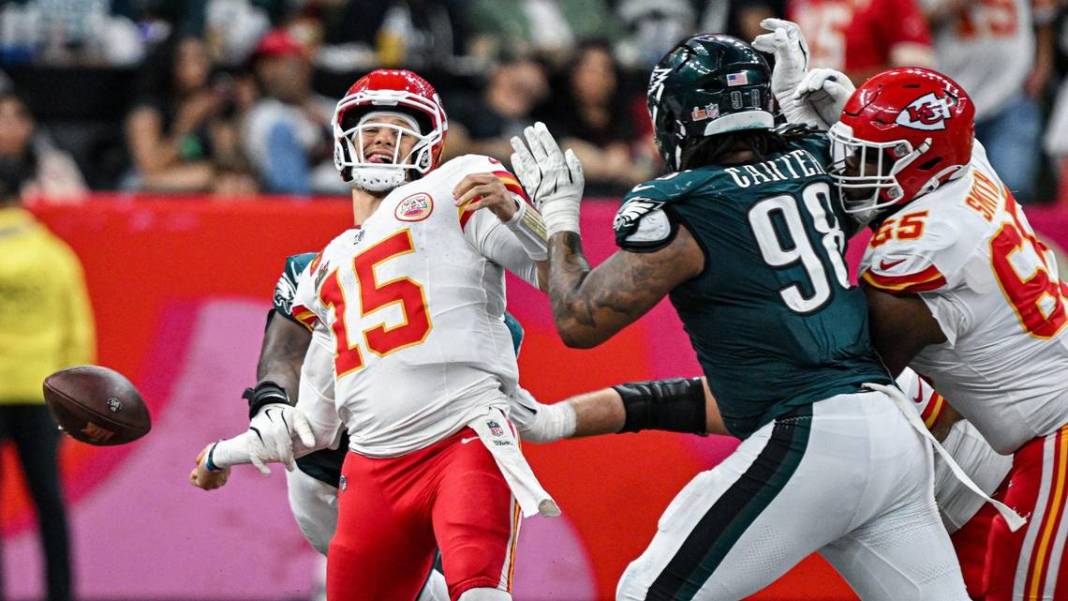

With much of the focus on the offensive line’s poor protection, Patrick Mahomes and the Chiefs’ skill players also had a rough Super Bowl. Even when Mahomes had time to throw, many of his usually precise passes were either off-target, too short, or too low. Uncharacteristic drops by tight end Travis Kelce were a reflection of the Chiefs’ struggles, as was a missed opportunity from DeAndre Hopkins, who was wide open and likely would have scored a touchdown to give the Chiefs life before halftime.
The Eagles’ secondary shut down Kansas City’s lackluster receiving corps, ensuring that even when Mahomes had time to throw, there was often little room for success. On several occasions, Mahomes’ passes found their way to Eagles defenders—one picked off and returned for a touchdown by cornerback Cooper DeJean, and another intercepted by linebacker Zach Baun deep in Chiefs territory, leading to a quick Eagles score that put Kansas City down by 24.

Photo Cred: AP News
It wasn’t until garbage time that the Chiefs offense showed any spark. Mahomes turned into “gunslinger” mode, lighting up rookie Xavier Worthy for 157 yards and two touchdowns, showcasing Worthy’s potential to star alongside Rashee Rice, who is set to return from injury. Hopkins added a touchdown, bringing the Chiefs within 18 points, but there was simply no time left. Hollywood Brown had just two catches for 15 yards, while Kelce managed only four catches for 39 yards. The Chiefs’ run game was equally ineffective. Despite the struggles in the passing game, KC couldn’t rely on their running backs.
Kareem Hunt had just three carries for nine yards, while Isiah Pacheco totaled only seven yards on the same number of carries. Surprisingly, Mahomes led the team on the ground with 25 yards, but even he couldn’t create enough offense through his scrambling ability. With no legitimate run threat, the Eagles had an easier time defending the pass, and the Chiefs’ offensive line couldn’t create lanes for the backs. While the Chiefs often rely on affordable, young talent at wide receiver and running back, they might consider following the Eagles’ model by signing an All-Pro running back or receiver to provide big-play potential when it’s most needed.
Too Much Focus on Barkley, Plus Blitz or Nothing
One of the biggest storylines leading up to the Super Bowl was how the Chiefs would stop Saquon Barkley. Barkley had over 2,000 yards in the regular season and was a threat in the postseason, but Steve Spagnuolo and the Kansas City defense had a plan. They loaded the box, holding Barkley to just 57 yards on 23 carries (2.3 yards per carry). While he added 40 receiving yards, his primary contribution was as a decoy.
The threat of the run forced the Chiefs to overcompensate, allowing the Eagles to take advantage of the passing game. Jalen Hurts connected with DeVonta Smith, A.J. Brown, and Jahan Dotson for big plays. Smith and Brown each had a touchdown, while Dotson nearly scored, setting up a Tush Push from the one-yard line to put the Eagles on the board.
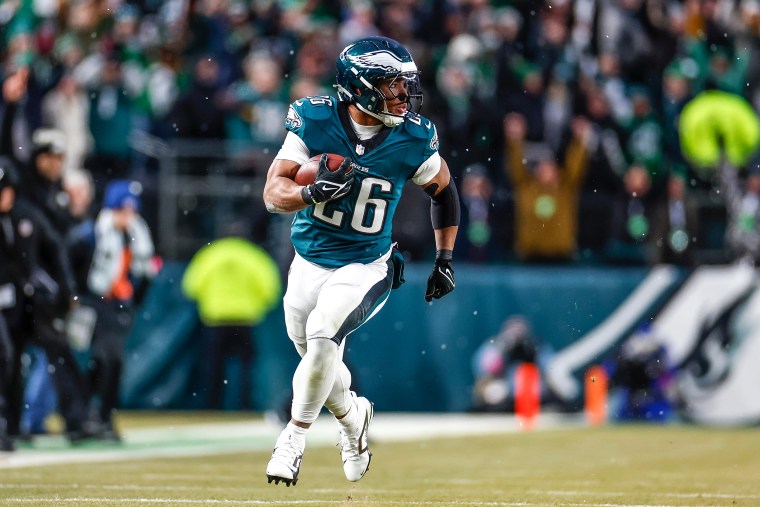
Photo Cred: AP News
The Chiefs’ defense excels at blitzing, with Spagnuolo often disguising coverages and unleashing pressure at critical moments. This tactic worked early in the game, with the Chiefs’ third-down pressure forcing an errant throw from Hurts that was intercepted by safety Bryan Cook, giving the Chiefs the ball still down by just seven. However, with the offense struggling, the defense had to return to the field repeatedly.
The problem with blitzing is that it’s not sustainable; the Eagles took advantage when the Chiefs didn’t blitz, allowing Hurts to find his receivers and move the ball downfield. The Chiefs’ coverage was lackluster, leaving huge gaps in zone coverage and getting beaten in man-to-man situations. The Chiefs have a strong front seven, but their secondary, filled with smaller names on modest contracts, couldn’t hold up against the Eagles’ talented receivers. Despite neutralizing the run game, the Eagles’ passing offense overwhelmed the Chiefs, a shocking turn considering how stingy the Kansas City defense had been throughout the season.
Takeaways
Football is a game of strategy, but the battle in the trenches often decides the outcome. In college football, talent disparity can make blowouts commonplace, but that kind of gap rarely exists in the NFL, let alone in the Super Bowl. However, the Chiefs found themselves facing this very issue once again. Even minor weaknesses in the offensive line wreaked havoc on Mahomes, throwing off the efficiency of their offense. To make matters worse, Mahomes and his skill players had an off game. While Mahomes struggled with errant throws, receivers dropped passes even when given the opportunity to break free of the Eagles’ pass rush.
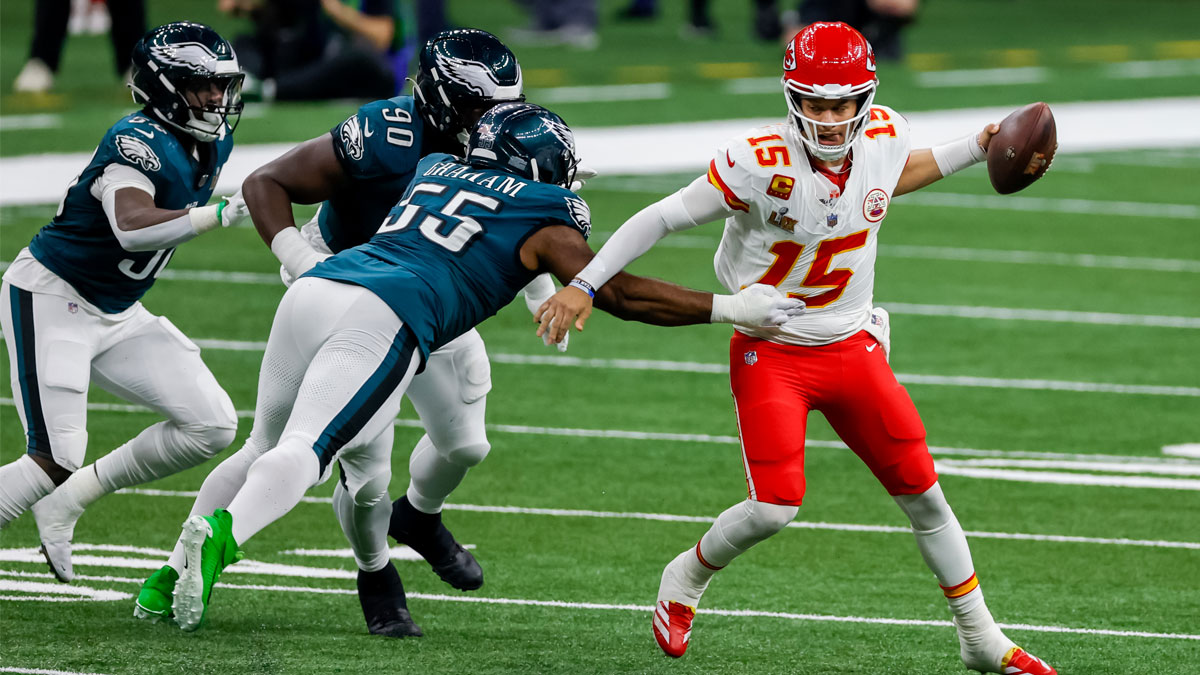
Photo Cred: NBC News
On defense, while the Chiefs made some plays, fatigue eventually took its toll. After being forced back onto the field repeatedly, the defense couldn’t keep up, failing to generate pressure or coverage against the Eagles’ potent passing attack. The run game was another area where the Chiefs struggled. Without a consistent run threat, the Eagles’ defense could focus entirely on stopping the pass. Barkley’s presence allowed Hurts and the Eagles’ offense to thrive, taking advantage of a lack of pressure and finding success both through the air and on the ground.
Finally, the Chiefs’ conservative offensive approach throughout the season hurt them. When they finally let Mahomes go into “gunslinger” mode in the latter stages of the game, he showed what he’s capable of—buying time, launching deep throws, and connecting with his receivers. Had they adopted this approach earlier, perhaps they could have found more offensive success. But by then, it was too little, too late. In the end, there were simply too many deficiencies for even the back-to-back champions to overcome.